PETER: Eh… Jesus…
JESUS: Yes, Peter…?
PETER: I’ve been thinking.
JESUS: Start the day with a miracle, is it?
PETER: No, seriously, Jesus, I’ve been thinking…
JESUS: What about, Peter?
PETER: About mission – and about the future.
JESUS: Into eschatology now, are we?
PETER: Escha … escha … escha-what-ogy?
JESUS: “Eschatology”, Peter. The “last things” – death, judgement, heaven, hell – the end of the world. You said you were thinking about the future.
PETER: Not that far into the future. I was thinking more about the immediate future.
JESUS: What about it?
PETER: Precisely Jesus – what about it? We can’t go on living like this.
JESUS: Like what, Peter?
PETER: Like “lilies of the field”. You say that they don’t worry about the future, so why should we? Come on, Jesus, get real! Ours is a field for mission, not flowers. If we’re going to go out proclaiming the kingdom of God, we’ve got to plan ahead. “Lambs among wolves” indeed! We’ll get eaten alive.
JESUS: What if I tell you to take some mint sauce along?
PETER: Come on, Jesus, I’m serious.
JESUS: Okay, Peter, tell me about these plans of yours.
PETER: Management theory.
JESUS: Pardon?
PETER: Management theory, Jesus. Haven’t you read the latest pack from Jerusalem? It’s all there. We need a system.
JESUS: A system?
PETER: Yes, a system. We’ve got a product, and we’ve got to sell it – we’ve got to be productive – and to be productive we need a system. It’s all about efficiency.
JESUS: I see.
PETER: We need to establish goals and set targets, and we need to prioritise.
JESUS: “Prioritise”?
PETER: Yes, I mean tax collectors and sinners? It’s a disgrace.
JESUS: I don’t do diss, Peter. But go on.
PETER: Where was I…? Yes, and we need to monitor, evaluate, assess.
JESUS: Of course.
PETER: I was thinking of a market research unit and a performance review team. And we’ll need a director of finance.
JESUS: But I’ve already appointed Judas as treasurer.
PETER: Bad choice according to the Micah-Baruch type test I ran him through, which was confirmed by the little focus group Jim and I set up.
JESUS: Who do you have in mind?
PETER: I’m drawing up a shortlist. And, of course, you’ll need a personal private consultant. And my first job will be to come up with a mission statement.
JESUS: Absolutely.
PETER: You know we don’t even have a mobile phone or a laptop. And we’ll have to have a blog.
JESUS: Is that “blog” as in Gog and Magog?
PETER: This isn’t a joke, Jesus. With that attitude no wonder we’re in such a state. But no more. From now on we’re going to be organised, with nothing left to chance, all the “i”s dotted and “t”s crossed. The future will be secure.
JESUS: So we’ll be profitable?
PETER: Yes.
JESUS: And successful?
`
PETER: Yes.
JESUS: And respected, admired, extolled?
PETER: I can see your picture now on the cover of Chronos: “Jesus of Nazareth: Man of the Year”!
JESUS: [Starts laughing.]
PETER: What’s so funny, Jesus?
JESUS: [Laughter increases.]
PETER: Why are you laughing?
JESUS: [Now in stitches.]
PETER: [Testily] Jesus!
JESUS: Peter, you’ve forgotten something absolutely crucial to good practice.
PETER: [Arrogantly] And what’s that?
JESUS: The No Asshole Rule.
via.
April 24, 2008


April 19, 2008
Onward to Austin

We're heading this morning to meet with a Realtor from our new church home to help find us a place to live. What we will probably do, since everything is happening so fast, is just rent for the summer in a place near the church then decide what to do after that. Although everyone says that the best time to buy is now, we're not sure if that's best for us right now. So, out of the hundreds of choices in Austin, pray that we'll find a place to call home.
On another note, last night I met with my group of India travelers for our orientation meeting. We leave on May 17. I've realized that I need to take some time to reflect on the trip, expectations, conversations, attitude, relationships, sights, food, and the opening of myself to a completely new and strange place.
I'm so excited, but have to make it through the next two weeks of papers and finals as well as moving to Austin.
April 11, 2008
So I got a J-O-B!
 It seems that after seminary I won't have to Barista or work for nothing, oh wait, that's called volunteering. That's right, I found a job, sure it's only a two year commitment, but we're really excited. Next weekend I will be announced at FBC Austin as the CBF Resident and upon my return from this India this June I'll start my first full time work.
My wife and I are incredibly excited about this opportunity. Some of you that know me may be wondering why I would choose another FBC/big church. First, we wanted to move to Austin and finding work in any field much less ministry is very difficult, because, c'mon who doesn't want to live in Austin?
Second, the CBF residency program is a really good opportunity to network, learn, and get paid to basically get a good mentoring experience. Not only will the residency program fulfill my requirement to graduate from Truett Seminary, but this will be my vocation. The program is unique, so that it's a little hard to explain, I mean, it's not like saying I'm a youth pastor, or associate pastor even. The CBF Residency affords me the opportunity to work in all the areas of the church even the one's I'm not interested in all that much.
Third, the church is a really cool faith community. Not only is there deep history, but as a self-described "cathedral church- a gathering place for all the people in the heart of the city," FBC is rich in diversity. My emphasis while at FBC will be in the youth (the youth minister and his wife are about to have twins), yet I'll get to preach, do children's ministry, college, administration, etc...everything. Also, I'm excited about being at a place where I'll fit in (more so) theologically and get an opportunity to explore my passion. It's only a two year commitment, which I good for my fourth reason.
Fourth, I'm still praying about and trying to figure out getting a terminal degree. If I do pursue something in academia I want it to be relevant for the church so that's another reason I'm excited about doing ministry in a healthy church focusing on many facets.
Fourth (and a half) reason, because as I'm thinking about long term future plans, which are exactly stable anyways we're also praying about the possibility of church planting. This has been one of my interests for while and I think instead of randomly choosing a city like Austin, we want to see if we fall in love with the city and this is where God wants us. I would like to be planted if I do church planting, if that's God's way anyways.
Fifth, living in Austin, being a part of FBC, and being given the freedom to pursue something that I would like within or for the church will give me the opportunity to figure out to move a church like this toward solidarity and social justice or community development.
As you can tell, we are pumped about this next move. We can't wait to move to Austin and get connected and sharing our lives. With the many possibilities ahead, as much as the future is open to us we are open to the future, the future hope of God's renewing Holy Spirit. Amen.
April 8, 2008
The Great Commandment

So I committed myself to using the Missio Dei Breviary for my morning and evening prayers. This little 4 week prayer book comes highly recommended by me, since it grows out of a Neo-Monastic community, focuses on Jesus' life, and has a strong social justice perspective. You can buy it, view the daily prayers online; or my favorite, flip through the entire book in issuu.
Now to move beyond the plug, seriously, check it out. I haven't done well, no really, I've sucked at using the breviary. Today though while I was meditating on the prayer, which begins with the Great Commandment. Now I know this commandment has been reinterpreted to help bring out the significance of the second command, yet I think it still gets tread under foot in light of the first.
The problem? Well, I don't think that Jesus in anyway meant to separate these two commands and place primacy or even priority of one over the other. Yet, we in our modern ways like to split atoms about everything then place those atoms in categories where certain preferences take precedence over others. This is what happens to these two commands. We read them, and see in verse 38 that the first command to "Love God" is the first and greatest, while the second is only like it. Therefore, we place the first over and even against the second as if we accomplish them in steps.
I think that Jesus summed the Law and Prophets using these two commands in reciprocal relationship to one to the other so that one cannot love God without loving one's neighbor, and one cannot love their neighbor without loving God. Thus, I reimagine the great commandment like this:
"Love God with all you have, and love your neighbor as if they are all you have."
What do you think of my rewording? Would you reword these verses and how?
I AM Liminal

First, click here.
Well, life around my house has been a little disturbed, frazzled maybe. In some sense, I feel like Murphy's Law has taken advantage of us. Charlotte's coworker has been out for 3 months on maternity leave and has had the worst substitutes, plus she's trying to prepare my month long hiatus to India coming up in May. We're both prepping ourselves for the news we'll receive tomorrow or Thursday...whether or not I have a job/mentoring in Austin. It's been a long wait full of anticipation and anxiety, so we'll let you know when we know. If I get the job, which I would really love to be there, I'll fill you in on what it is.
Beyond that, for a few weeks my car broke down and my father drove down 5 hours to help get it running, so that's why I want you to click here to drive up hits on his web business. It's the least I can do, and all you have to do is click. Also, Charlotte's phone broke, our printer broke, we had our electricity cut off for 24 hours (to not fault of our own), my dog ran away but was found, and I kind of fell behind in school.
This last part is the worst part for me. This is my last semester of classes for my MDiv, and am really excited about my classes. I want to finish strong and I have 6 papers in about 3 weeks and then I'll be leaving for India. If I do get this job in Austin (which I want), then I'll hint the ground running and I'm wanting to make sure I prepare for India correctly.
So to finish up, click here. Oh, and thanks for the prayer...as you can tell from this rambling of a post, I'll need it to get through the semester.
April 4, 2008
Praying Bitterness Out
Prayer is participation in willing God's will.
-Marjorie J. Thompson
To pray is to change. Prayer is the central avenue God uses to transform us.
-Richard Foster
-Marjorie J. Thompson
To pray is to change. Prayer is the central avenue God uses to transform us.
-Richard Foster
And I had a third quote, but I lost it so here's a paraphrase (if someone can correct and point me in the direction of the author, I'd appreciate it):
Religion is knowing that there is more than just the facts that we see.
I thought these quotes were appropriate in the face of my last post. Sometimes in the face of jaded and embittering situations, all we can do is pray. Prayer though is so much more than all we can do.
April 3, 2008
In Bitter Protest Against Embitterment
So one of my friends is going through some crap right now with his church and he shared it in class. In the end it could be very easy for him to get bitter about the whole situation, hell, with church in general. Then on of my professor's offered some words of advise, I'm not so sure they were encouragement, but he said that life is basically full of disappointments. This principle is especially true in ministry and churches, because there exists different expectations for "God's" people, right?
Well, this got me thinking about my experience in seminary. Sometimes I feel like the three to four years we devote to theological study and training is in preparation for ministry by way of learning to deal with being jaded, burned, and embittered. One of the things I've come to realize is that when we take something we love and place it in a microscope all the time, all of its faults, and deformations come to bear. We're allowed to vocalize all that we think is wrong with the church, ministries, hermeneutics, homiletics, etc. In this setting of constantly and almost overwhelmingly studying God, ministry, and the church it is very easy to get a sense that everything is not "alright."
Life, especially in the ministry, is full of broken relationships that can easily lead to bitterness and mistrust. I think sometimes seminary trains us deal with those feelings, because the real question is how are you going to stop from getting so bitter, frustrated, and jaded that you lose sight of what is really important. Failure is inevitable. The possibility for bitterness is inevitable, no, bitterness is inevitable.
So, the real question is what are you going to do with it?
I ask myself this everyday as I think about theology and my life. I ask myself this every Sunday I drive to our church. I ask this daily in the seminary classroom. What are you going to do with it? What are you going to do when the people you love fail you? When it feels like God is failing you? When you are failing you?
Sometimes it's best to remember that where bitterness may justify our feelings, mistrust can mark our lives, and we can become so jaded to lose touch with our faith, we should always count on love.
In the end, love wins...and sometimes grace pokes its ugly head in the most peculiar of situations.
Well, this got me thinking about my experience in seminary. Sometimes I feel like the three to four years we devote to theological study and training is in preparation for ministry by way of learning to deal with being jaded, burned, and embittered. One of the things I've come to realize is that when we take something we love and place it in a microscope all the time, all of its faults, and deformations come to bear. We're allowed to vocalize all that we think is wrong with the church, ministries, hermeneutics, homiletics, etc. In this setting of constantly and almost overwhelmingly studying God, ministry, and the church it is very easy to get a sense that everything is not "alright."
Life, especially in the ministry, is full of broken relationships that can easily lead to bitterness and mistrust. I think sometimes seminary trains us deal with those feelings, because the real question is how are you going to stop from getting so bitter, frustrated, and jaded that you lose sight of what is really important. Failure is inevitable. The possibility for bitterness is inevitable, no, bitterness is inevitable.
So, the real question is what are you going to do with it?
I ask myself this everyday as I think about theology and my life. I ask myself this every Sunday I drive to our church. I ask this daily in the seminary classroom. What are you going to do with it? What are you going to do when the people you love fail you? When it feels like God is failing you? When you are failing you?
Sometimes it's best to remember that where bitterness may justify our feelings, mistrust can mark our lives, and we can become so jaded to lose touch with our faith, we should always count on love.
In the end, love wins...and sometimes grace pokes its ugly head in the most peculiar of situations.
March 29, 2008
March 27, 2008
March 24, 2008
March 23, 2008
Easter Dance

"With Easter the laugher of the redeemed, the dance of the liberated and the creative play of fantasy begins. According to Hippolytus the risen Christ is the 'leader of the mystic round-dance' and the church is the bride who dances with him." - Jurgen Moltmann, Church in the Power of the Spirit, 110.
March 22, 2008
Evangelism Tools
 David Fitch, the author of the Great Giveaway, has an interesting post on the creation of a more "missional evangelism tool." I'm not sure how I feel about this, I mean, I think evangelism should be much more fluid than we often make it out to be. For instance, why don't we need tools or cubes to explain our love for baseball, cars, jobs, etc. Those things we seek after and care about are simply natural parts of our lives and conversations, but because we've bifurcated our faith we need some tools for evangelism.
I did find a few things interesting in his post though. One commenter has created a website for a tool, and I kind of like this video on sharing your faith using a legal pad. Also, here's a church's "umbrella metaphor" video that I find particularly unhelpful.
What do you think? Should we or do we need tools for evangelism?
March 21, 2008
Good Friday

In Christianity the cross is the test of everything which deserves to be called Christian. (p. 7)
Christian identity can be understood only as an act of identification with the crucified Christ, to the extent to which one has accepted the proclamation that in him God has identified himself with the godless and those abandoned by God, to whom one belongs oneself. (p. 19)
Christian identification with the crucified Christ means solidarity with the sufferings of the poor and the misery of both the oppressed and the oppressors. (p. 25)
-Moltmann, The Crucified God
Picture of Brazilian sculptor Guido Rocha's art revealing that Christ really did suffer. via.
What Would Jesus Eat?
My buddy Lucas has launched a new blog called What Would Jesus Eat? There's no one I know that I would trust more on this issue, I mean, he helped inspire my family's Lenten fast from meat (there's poo in that patty). In years to come following his mastering of the divine from this place, Lucas and his wife Sarah plan on loading up the family and moving to the World Hunger Farm to serve the Kingdom and work with food issues.
Go check it out, he has some really good thoughts on what we're eating and how following Christ might just affect that.
Go check it out, he has some really good thoughts on what we're eating and how following Christ might just affect that.
March 15, 2008
Perception
Here's a few videos that I hope to draw up some lessons on perception, enculturation, ethnocentricism, and learning to listen and open ourselves up to the world.
Subliminal messaging: interesting video on how our surrounding culture and context shapes our perception, imagination, and world.
Blind Painter: this is one of the most amazing things I've ever seen. Esref Armagan is a painter from Turkey who paints beautiful landscapes and architecture- and he was born BLIND.
EDIT: Sorry, I didn't mean to post it originally in a foreign language. Above is the English video.
Awareness Test: if you only have a few minutes, you definitely need to watch this one:
Subliminal messaging: interesting video on how our surrounding culture and context shapes our perception, imagination, and world.
Blind Painter: this is one of the most amazing things I've ever seen. Esref Armagan is a painter from Turkey who paints beautiful landscapes and architecture- and he was born BLIND.
EDIT: Sorry, I didn't mean to post it originally in a foreign language. Above is the English video.
Awareness Test: if you only have a few minutes, you definitely need to watch this one:
March 3, 2008
Praying the Hours
 Since my trip to New Mexico to pray with monks in the desert, I've been drawn to rhythmic, orderly prayer. Tim Keel, pastor at Jacob's Well has posted some excellent resources for praying the hours. Tim says this,
The discipline of fixed-hour prayer is a challenging practice for most people to begin to engage because for many of us it is such an alien orientation to a spiritual practice that has largely been individual, spontaneous, and self-directed.Hope this help in some way. I highly recommend fixed hour prayer, although I suck at it. There is something about moving in and out of prayer towards work and life, instead of the other way around.
Everybody Wants to go to Heaven, but Nobody knows it's a Lie!
 It seems that the gospel for too long has been about where we'll end up after we die. Sadly, we begin evangelism with the question (and not relationship), "if you were to die today, would you go to heaven?"
Obsession. Failure. Misguided. Irrelevant.
N.T. Wright has become one of the most formidable and brilliant N.T. scholars of our generation. I agree with him in many ways on his recent book. You can see what he has to say about why heaven doesn't exist in this piece for Time (I really recommend the read, it's well worth it). Because of our unseen Greek influences, heaven has become a matter of discourse for anyone who would dare call themselves a Christian. In the end this leads to a dualism never intended by the N.T. writers or God, I think.
The final book of the Bible, Revelation declares that when Jesus comes back, believers won't be swooped into heaven while the rest experience some tribulation-like some whacked out authors have written. Jesus was resurrected with his new body bearing the marks of crucifixion. This earth too will experience new creation, a resurrection bearing the marks of the crucifixion that it is suffering at the hands of its so called caretakers.
Being Christian does not exempt us from being human. We must ca
 re for this world and for people (not simply their souls). It is time we rethought heaven, earth, resurrection, and the future plight of creation intended by God. Towards the earth, we must take care of God's creation for it is on loan from our children. Towards our neighbor, we must seek and create meaningful relationships that care for and allow for that person to share who they truly are and care for their real needs. Towards God, we must be humble enough to allow him to break the boxes we force him to reside in.
March 2, 2008
Religion Engaging the Secular
Here's a short video of one of my favorite New Testament scholars, N.T. Wright from Allelon.
February 29, 2008
February 28, 2008

Please READ...
There is nothing like religion, politics, and parenting to bring out people's ignorance. I'll admit, in reverse order to the above list, I am ignorant. But something I have learned is to listen. When my brother and sister-in-law talk about parenting, I listen. When my pastor talks about church, I listen. When the media talks about politics, I listen. And here is the rub, I disagree with all three of the mediums I justed listed in certain respects.
So I ask you whether or not your values line up with mine, or your beliefs about religion line up with mine, please just listen. For the first time in my life, I have really been involved and tried to learn about our presidential hopefuls. I in no way declare political allegiance, because my allegiance lies elsewhere.
But, this race is clouded by ignorance especially concerning Barack Obama. I've received enough emails to publish a small book declaring "Don't vote for Obama, He's a Muslim!!!" This my friends and family is trash. Any Christian who passes this email is in desperate need of repentance, because I can think of no clearer case of slander and unwholesome talk.
I'm just going to say this once, Obama is in no way a Muslim. To refute this is to reveal your ignorance, so please stop. Here's his church, which by the way, is pastored by one of Ebony magazine's best 15 US pastors, oh and yes the church is confessionally black, but not "black nationalist" (if you react against this statement, then yes you are more racist than you realize). And yes, white folks do go and are welcomed in this community.
But what about these alleged and fallacious claims that Obama is tied to the Nation of Islam leader Louis Farrakhan in Chicago (Obama's home)? Or his upbringing in a Muslim home attending the madrassa Muslim school? REALITY is is that Obama talks about coming from an AGNOSTIC home and while working alongside Christian churches in Chicago doing community development. As he relates in The Audacity of Hope, Obama retells how he walked the aisle and personally gave his life to Christ. And he has constantly tried to separate himself from Farrakan. "I live in Chicago. He lives in Chicago. I've been very clear, in terms of me believing that what he has said is reprehensible and inappropriate. And I have consistently distanced myself from him," Obama relates.
I do not write this as a political piece in order to promote or even endorse Obama. I write this as a Christian who believes that we are called to live above reproach and purity, and to speak with wholesome, pure, and truthful words. As write this as a brother in Christ who hopes this will be a step in removing the log in our own eyes, before pointing out the splinters in everyone else's.
Inspired by Jim Wallis, a CHRISTIAN political leader who recently defended Obama.
So I ask you whether or not your values line up with mine, or your beliefs about religion line up with mine, please just listen. For the first time in my life, I have really been involved and tried to learn about our presidential hopefuls. I in no way declare political allegiance, because my allegiance lies elsewhere.
But, this race is clouded by ignorance especially concerning Barack Obama. I've received enough emails to publish a small book declaring "Don't vote for Obama, He's a Muslim!!!" This my friends and family is trash. Any Christian who passes this email is in desperate need of repentance, because I can think of no clearer case of slander and unwholesome talk.
I'm just going to say this once, Obama is in no way a Muslim. To refute this is to reveal your ignorance, so please stop. Here's his church, which by the way, is pastored by one of Ebony magazine's best 15 US pastors, oh and yes the church is confessionally black, but not "black nationalist" (if you react against this statement, then yes you are more racist than you realize). And yes, white folks do go and are welcomed in this community.
But what about these alleged and fallacious claims that Obama is tied to the Nation of Islam leader Louis Farrakhan in Chicago (Obama's home)? Or his upbringing in a Muslim home attending the madrassa Muslim school? REALITY is is that Obama talks about coming from an AGNOSTIC home and while working alongside Christian churches in Chicago doing community development. As he relates in The Audacity of Hope, Obama retells how he walked the aisle and personally gave his life to Christ. And he has constantly tried to separate himself from Farrakan. "I live in Chicago. He lives in Chicago. I've been very clear, in terms of me believing that what he has said is reprehensible and inappropriate. And I have consistently distanced myself from him," Obama relates.
I do not write this as a political piece in order to promote or even endorse Obama. I write this as a Christian who believes that we are called to live above reproach and purity, and to speak with wholesome, pure, and truthful words. As write this as a brother in Christ who hopes this will be a step in removing the log in our own eyes, before pointing out the splinters in everyone else's.
Inspired by Jim Wallis, a CHRISTIAN political leader who recently defended Obama.
February 26, 2008
February 25, 2008
Updated Blog
As you can tell, I've updated my blog which has been long overdue. I was quite tired of the last template and I really like this one. I was just about ready to give up on Blogger when my first template totally screwed up and wouldn't work after working on it for hours.
The header is a great picture of my journey last summer to Christ in the Desert Monastery in the desert of New Mexico where I prayed the hours with a the monks. The trip was refreshing, but at the same time brought up the questions of how we may this life accessible to everyday people, what seems like the colliding of two worlds.
The painting on the right was hijacked from Flickr, which is a public photo sharing community so I hope its legal even though the painting is copy righted. Check out the artists other works. The name of the piece is LABYRINTH: Maybe I am Crazy. I chose it because after searching unsuccessfully for a good Kaleidoscope picture, I came across this one and it expresses well my faith journey. As the blog is titled, my faith has been a collision of sorts resulting in myriad shapes, forms, and colors in my life. In my head these are the things I want so much to bring together: faith, life, culture, community, nature, the world, and Christ; but I have such a difficult time doing. When these various pieces amalgamate the effect is often a crash resulting in the perspective I call collideOscope.
The header is a great picture of my journey last summer to Christ in the Desert Monastery in the desert of New Mexico where I prayed the hours with a the monks. The trip was refreshing, but at the same time brought up the questions of how we may this life accessible to everyday people, what seems like the colliding of two worlds.
The painting on the right was hijacked from Flickr, which is a public photo sharing community so I hope its legal even though the painting is copy righted. Check out the artists other works. The name of the piece is LABYRINTH: Maybe I am Crazy. I chose it because after searching unsuccessfully for a good Kaleidoscope picture, I came across this one and it expresses well my faith journey. As the blog is titled, my faith has been a collision of sorts resulting in myriad shapes, forms, and colors in my life. In my head these are the things I want so much to bring together: faith, life, culture, community, nature, the world, and Christ; but I have such a difficult time doing. When these various pieces amalgamate the effect is often a crash resulting in the perspective I call collideOscope.
Is the Gospel Startling?
I recently came across this post. It's more or less a midrash on John 4, the story of the Jesus in Samaria and the woman at the well. I've posted the Scripture midrash in its entirety because, well, it's just that good.
"Jesus Talks With A Gay Man - (John 4:1-33, 39-42 - more or less...)
1 In late July, the Metro Chicago Synod heard that Jesus was attracting more first-time visitors and baptizing more adults than any other ELCA pastor in the city, 2 although in fact it was not really Jesus who had baptized them, but his irregularly-commisioned staff of unordained lay ministers. 3 Now when Jesus learned of this, he left the seminary community in Hyde Park and went back once more toward the ELCA headquarters on Higgins Road.
4 Now to get there, he had to go through an area just north of downtown called Boystown. 5 So he came to a part of Boystown called Northhalsted, not far from the plot of ground whereEmperor Mayor Daley had ordained that the Chicago Cubs should play baseball. 6 Cub's Stadium was near there, and Jesus, tired as he was from the journey on the Red Line, sat down at a sidewalk café table outside the bar called Hydrate. It was just about lunch-time, and though the rainbow flags were fluttering in the breeze and the music inside the bar was pumping, there weren't many people around (because it's often hot and miserable outside, at mid-day in late July, in Chicago).
7 A waiter came to the table, wearing a bright pink "His+His" t-shirt and a "Silence=Death" armband, and raised one eyebrow at the man seated at the table in front of him in the "Come Follow Me" t-shirt. Jesus said to him, "Will you give me a drink?" 8 (All the lay ministers had gone down the street to pick up Subway sandwiches for the rest of the journey.)
9 The gay man said to him, "Hey...you tell me. After all, you appear to be a straight Christian, and I'm a gay man. Let's face it - we don't get many religious folks in Boystown, let alone places like this. And I'm not only a gay man, but I'm a Muslim gay man. So where does a guy like you get off asking someone like me for a drink?" (For Christians do not associate with gays, nor with Muslims if they can help it.)
10 Jesus answered him, "If you knew the gift of God and who it is that asks you for a drink, you would have asked him and he would have given you living water."
11 "Hey, mister," the gay man said, "I'm the waiter here. I don't see you with an order pad or a serving tray, and it's tough for customers to even get close to our fountain-drink station, let alone our bar. So how are you going to get anything for me to drink, let alone 'living water'? Where can you get this living water? 12 Are you somehow greater than the folks who own this place, who let us drink have free water and soda (and snitch the occasional mixed drink) whenever we want?"
13 Jesus answered, "Everyone who drinks your water, or your soda, or your beer will get thirsty again, 14 but whoever drinks the water I give him will never thirst. Indeed, the water I give him will become in him a spring of water welling up to eternal life."
15 The gay man said to him, "Yeah? Mister...you know what, I have no idea who you really are, or even what the heck you're talking about. But you're the first Christian man in 20 years that hasn't spit on me, or called me 'an abomination' to my face. Somehow, I think I want some of what you're offering. Give me some of this water you keep talking about, so I won't get thirsty and have to keep coming here to get something to drink."
16 Jesus told the man, "OK - just call your wife and come back here, and we'll talk."
17 "Who are you kidding?" the gay man said. "Don't you know where you are? You're in Boystown, for cryin' out loud. I don't have a wife, or a girlfriend. Heck, right now I don't even have a boyfriend," he replied.
Jesus said to her, "You're right when you say you have no boyfriend. The fact is, you've had five boyfriends, and the guy you're living with now isn't even your boyfriend. He's just a guy you picked up in the club - some guy who doesn't even know your real last name."
19 Whoah, buddy," the gay man said, "that's pretty intense! How'd you know that about me?" Jesus was silent. "OK...I get it. Maybe you're one of those folks who can see right through people - maybe one of those guys with 'second sight.' Maybe you're one of those folks who 'have the Spirit,' like those televangelists say. 20 I don't know anything about that. My family - my people (the ones who are observant, anyway) - think that you have to pray five times a day to Allah to get that kind of power. The rest of the people I know don't even bother with that spiritual mumbo-jumbo...they just think you have to work out a lot, look good, live fast, die hard and leave a good-looking corpse. And all the Christians I've met think that I have to pray their way, and start living life their way, or I'm 'going to hell.' Either way, my day-to-day life is so empty, I'm not convinced that I'm not already in hell. What's a guy supposed to believe?"
21 Jesus said, "Believe me, my friend, a time is coming when you won't worship God in Mecca, or in the gym, or in the club, or in a church sanctuary. 22 You and your friends worship what you think you know, but do not know. Christians worship what they do know, for salvation is promised in Scripture. 23 Yet a time is coming - and has now come - when the true worshipers will worship the Father in spirit and truth, for they are the kind of worshipers the Father seeks. 24 God is spirit, and his worshipers must worship in spirit and in truth."
25 The gay man said, "I know that the church folks say that their Savior is coming. Maybe when he finally gets here, he will explain everything to us."
26 Then Jesus declared, "Then wait no longer. I'm the one they're waiting for."
The Irregularly-Commissioned Lay Ministers Rejoin Jesus
27 Just then the lay ministers returned and were more than a little surprised to find Jesus apparently talking with a gay man - one who appeared to be Middle-Eastern in origin, to boot. But no one asked, "What do you want?" or "Why are you talking with him?"
28 Then, leaving his tray and his order pad behind at the table, the gay man went back to the bar, and even next door to the gym and to the other clubs, and said to the people, 29 "You gotta come and see this... come see a guy who told me everything I ever did, and didn't run away or act disgusted. Could this possibly be 'the Christ' all those religious folks keep talking about?" 30 People came out of the gym, and out of the bars and clubs, and made their way toward him.
31 Meanwhile the lay ministers (the ones who considered themselves Jesus' disciples) kept saying, "Hey, padré, you may walk on water, but come on - even Michael Jordan's gotta eat something." 32 But Jesus said to them, "I have a source of energy that you know nothing about."
33 Then his disciples said to each other, "Did someone slip him some Mrs. Field's cookies while we weren't looking?"
....
Many Gays and Lesbians Believe
39 Many of the gays and lesbians who gathered from all around Boystown believed in Jesus because of what the waiter said: "You gotta come and see this... come see a guy who told me everything I ever did, and didn't run away or act disgusted." 40 So when the people of that area - gay men, lesbians, bisexuals (even people in civil unions from Vermont and Episcopalians visiting from New Hampshire) came to him, they urged Jesus to stay with them. So rather than continuing the ride out to Higgins Road, the irregularly consecrated lay ministers found some rooms at a nearby bed-&-breakfast, and he stayed in Boystown - amidst the people with whom most Christians would not associate - for two days. 41 And because of what Jesus spoke to the men and women there, many more became believers.
42 The people who heard Jesus said to the gay man who first encountered him, "We no longer believe just because of what you said; now we have heard for ourselves, and we know that this man really is the Savior of the world."
+ + +
Yes, Virginia - yes indeed...the Gospel really IS that shocking."
"Jesus Talks With A Gay Man - (John 4:1-33, 39-42 - more or less...)
1 In late July, the Metro Chicago Synod heard that Jesus was attracting more first-time visitors and baptizing more adults than any other ELCA pastor in the city, 2 although in fact it was not really Jesus who had baptized them, but his irregularly-commisioned staff of unordained lay ministers. 3 Now when Jesus learned of this, he left the seminary community in Hyde Park and went back once more toward the ELCA headquarters on Higgins Road.
4 Now to get there, he had to go through an area just north of downtown called Boystown. 5 So he came to a part of Boystown called Northhalsted, not far from the plot of ground where
7 A waiter came to the table, wearing a bright pink "His+His" t-shirt and a "Silence=Death" armband, and raised one eyebrow at the man seated at the table in front of him in the "Come Follow Me" t-shirt. Jesus said to him, "Will you give me a drink?" 8 (All the lay ministers had gone down the street to pick up Subway sandwiches for the rest of the journey.)
9 The gay man said to him, "Hey...you tell me. After all, you appear to be a straight Christian, and I'm a gay man. Let's face it - we don't get many religious folks in Boystown, let alone places like this. And I'm not only a gay man, but I'm a Muslim gay man. So where does a guy like you get off asking someone like me for a drink?" (For Christians do not associate with gays, nor with Muslims if they can help it.)
10 Jesus answered him, "If you knew the gift of God and who it is that asks you for a drink, you would have asked him and he would have given you living water."
11 "Hey, mister," the gay man said, "I'm the waiter here. I don't see you with an order pad or a serving tray, and it's tough for customers to even get close to our fountain-drink station, let alone our bar. So how are you going to get anything for me to drink, let alone 'living water'? Where can you get this living water? 12 Are you somehow greater than the folks who own this place, who let us drink have free water and soda (and snitch the occasional mixed drink) whenever we want?"
13 Jesus answered, "Everyone who drinks your water, or your soda, or your beer will get thirsty again, 14 but whoever drinks the water I give him will never thirst. Indeed, the water I give him will become in him a spring of water welling up to eternal life."
15 The gay man said to him, "Yeah? Mister...you know what, I have no idea who you really are, or even what the heck you're talking about. But you're the first Christian man in 20 years that hasn't spit on me, or called me 'an abomination' to my face. Somehow, I think I want some of what you're offering. Give me some of this water you keep talking about, so I won't get thirsty and have to keep coming here to get something to drink."
16 Jesus told the man, "OK - just call your wife and come back here, and we'll talk."
17 "Who are you kidding?" the gay man said. "Don't you know where you are? You're in Boystown, for cryin' out loud. I don't have a wife, or a girlfriend. Heck, right now I don't even have a boyfriend," he replied.
Jesus said to her, "You're right when you say you have no boyfriend. The fact is, you've had five boyfriends, and the guy you're living with now isn't even your boyfriend. He's just a guy you picked up in the club - some guy who doesn't even know your real last name."
19 Whoah, buddy," the gay man said, "that's pretty intense! How'd you know that about me?" Jesus was silent. "OK...I get it. Maybe you're one of those folks who can see right through people - maybe one of those guys with 'second sight.' Maybe you're one of those folks who 'have the Spirit,' like those televangelists say. 20 I don't know anything about that. My family - my people (the ones who are observant, anyway) - think that you have to pray five times a day to Allah to get that kind of power. The rest of the people I know don't even bother with that spiritual mumbo-jumbo...they just think you have to work out a lot, look good, live fast, die hard and leave a good-looking corpse. And all the Christians I've met think that I have to pray their way, and start living life their way, or I'm 'going to hell.' Either way, my day-to-day life is so empty, I'm not convinced that I'm not already in hell. What's a guy supposed to believe?"
21 Jesus said, "Believe me, my friend, a time is coming when you won't worship God in Mecca, or in the gym, or in the club, or in a church sanctuary. 22 You and your friends worship what you think you know, but do not know. Christians worship what they do know, for salvation is promised in Scripture. 23 Yet a time is coming - and has now come - when the true worshipers will worship the Father in spirit and truth, for they are the kind of worshipers the Father seeks. 24 God is spirit, and his worshipers must worship in spirit and in truth."
25 The gay man said, "I know that the church folks say that their Savior is coming. Maybe when he finally gets here, he will explain everything to us."
26 Then Jesus declared, "Then wait no longer. I'm the one they're waiting for."
The Irregularly-Commissioned Lay Ministers Rejoin Jesus
27 Just then the lay ministers returned and were more than a little surprised to find Jesus apparently talking with a gay man - one who appeared to be Middle-Eastern in origin, to boot. But no one asked, "What do you want?" or "Why are you talking with him?"
28 Then, leaving his tray and his order pad behind at the table, the gay man went back to the bar, and even next door to the gym and to the other clubs, and said to the people, 29 "You gotta come and see this... come see a guy who told me everything I ever did, and didn't run away or act disgusted. Could this possibly be 'the Christ' all those religious folks keep talking about?" 30 People came out of the gym, and out of the bars and clubs, and made their way toward him.
31 Meanwhile the lay ministers (the ones who considered themselves Jesus' disciples) kept saying, "Hey, padré, you may walk on water, but come on - even Michael Jordan's gotta eat something." 32 But Jesus said to them, "I have a source of energy that you know nothing about."
33 Then his disciples said to each other, "Did someone slip him some Mrs. Field's cookies while we weren't looking?"
....
Many Gays and Lesbians Believe
39 Many of the gays and lesbians who gathered from all around Boystown believed in Jesus because of what the waiter said: "You gotta come and see this... come see a guy who told me everything I ever did, and didn't run away or act disgusted." 40 So when the people of that area - gay men, lesbians, bisexuals (even people in civil unions from Vermont and Episcopalians visiting from New Hampshire) came to him, they urged Jesus to stay with them. So rather than continuing the ride out to Higgins Road, the irregularly consecrated lay ministers found some rooms at a nearby bed-&-breakfast, and he stayed in Boystown - amidst the people with whom most Christians would not associate - for two days. 41 And because of what Jesus spoke to the men and women there, many more became believers.
42 The people who heard Jesus said to the gay man who first encountered him, "We no longer believe just because of what you said; now we have heard for ourselves, and we know that this man really is the Savior of the world."
+ + +
Yes, Virginia - yes indeed...the Gospel really IS that shocking."
February 24, 2008
February 23, 2008

February 22, 2008
Presidential Hopefuls God-O-Meter
Follow this link to find where your presidential hopeful lands on the God-O-Meter.
Seemless Christianity
Kester at Signs of Emergence has an interesting post inspired by the 14 Grand Engineering Challenges of the 21st Century where he asked around seeking answers to the question: what are the 'grand challenges' for theology for the 21st Century? The multivalent answers not only reveal proclivities, but also show that this question a bit, well...dualistic? esoteric? uhm, shortsighted?
Theology as mainly an academic sort of esoteric activity of professional clergy or professors is quickly losing its relevance and for good reason. In church culture or christendom today there a seems to be a pervasive attitude within the community that theology is for the professional to produce and a commodity to be received. Simply stated, there is alot of bad theology ranging from the health and wealth gospels to myopic-soul salvation gospels. Why? Partly, but certainly not wholly because the church has become a place for the people, where people come to receive from the professionals; instead a church of the people where the school teacher, engineer, art director, construction worker, or business executive struggle with theology in life.
My humble response to the question was inspired especially by Sue Wallace's quote
The very reason this is a problem is because we have a Christian subculture that is separate from the world, always chasing after the world (irony?) trying to keep up and realize the trends thus creating secondary and often bad art, music, clothes, and books.
My response:
Theology as mainly an academic sort of esoteric activity of professional clergy or professors is quickly losing its relevance and for good reason. In church culture or christendom today there a seems to be a pervasive attitude within the community that theology is for the professional to produce and a commodity to be received. Simply stated, there is alot of bad theology ranging from the health and wealth gospels to myopic-soul salvation gospels. Why? Partly, but certainly not wholly because the church has become a place for the people, where people come to receive from the professionals; instead a church of the people where the school teacher, engineer, art director, construction worker, or business executive struggle with theology in life.
My humble response to the question was inspired especially by Sue Wallace's quote
There is a sense in which the biggest theological challenges will always be the ones of cultural communication, and the frustrating thing is that as soon as we have sussed out how to speak one language, the world has moved on, and we have to learn another if we are to engage in serious dialogue, and offer true hope rather than incomprehensible poetry.
The very reason this is a problem is because we have a Christian subculture that is separate from the world, always chasing after the world (irony?) trying to keep up and realize the trends thus creating secondary and often bad art, music, clothes, and books.
My response:
The task of theology will be to empower the church of the people (not professionals for the people) to imaginatively follow Christ while living in the world thus not creating a separate culture but a community of hope and love that grapples with the real problems of the world, ie: poverty, enviromentalism, nuclear weapons, war, genocide, open relationships to the "other" [for example] looking to the future hope of new creation, resurrection.
February 18, 2008
The Intimate Truth on Objective Truth, Pt. 5
 Finally, I come to the conclusion of series on all things objectively true, relative, and intimately true. You can check out Part 1, 2, 3, & 4.
Simple stated, I do not believe that objective truth exists. Let me nuance that, I do not believe that we can know the Truth objectively without our frame of reference, particularities, culture, and values guiding what and how we think. I do believe there is Truth, so not I don't we're left with relativism, but to a faithful relativity. We need story, traditions, cultures, history, along with scientific reasoning to get to the truth.
Everything outside of reason though was erased from the methods of seeking truth with Kant who said that religion has to fit within the bounds of reason. Nicholas Wolterstorff, a Christian philospher, flips Kant's line on its head by saying that reason must fit within the bounds of reason.
Most people who are squeemish at the mention of nonobjectivity are those moderns who ahve bought into the idea that truth can be had apart from one's perspective. Reasoning is core and foundational to what it means to be human, and humans are seemingly by nature religious. Even if you can't admit that humans are religious by nature, I think you must admit that we cannot escape our place in life, who we are, our enculturation process.
The most important reason for myself to pull back the curtains on objectivity to realize that it truly is a bankrupt commission, is because too often religion adherents (especially Christians) claim to have THE OBJECTIVE TRUTH. Many consequences follow, but the worst that I find in my Western, white middle class context is Christians claim that the gospel is objectively true while pulling away from the church as the center of truth. So what is lost when we claim the gospel is objectively true? We lose embodied witness. Why live out the gospel when I can point to an objective truth that exists outside of reality?
God though did not find it fit to drop facts and knowledge to be known as truth, but rather God dropped a baby into the world that one day would proclaim himself as "the Way, the Truth, and the Life." Truth can only be known in faithful, covenant relationship. We must be in faithful relationship to ourselves in our context, to traditions, religions, cultures, histories, reasoning, philosophy, art, and most importantly God.
February 4, 2008
February 1, 2008
The Intimate Truth on Objective Truth, Pt. 4

In continuation of my series on truth, Pt. 1, Pt. 2, Pt. 3, and one of my reasons, today I'll try to construct how truth is understood rather than objective. Usually, when I get this far into this conversation with truth the answer suggested is that we should just strive for a more objective, objectivity or humble objectivity. Seems like a noble enough goal. But I hardly think it's an answer.
The way we understand truth is based on the way we understand the world. Ontology precedes epistemology. For example, when you understand the world as an objective reality that works like a machine we study it and make it submit to our desires. Fundamentally, we describe the world as a "watch" built by the "watchmaker." Thus, when the world is understood in materialistic terms the techniques for materialistic knowledge will be elevated above all others, "This is just the way the world is or works."
The Bible though does not talk about the world in mere materialistic and mechanistic terms, but rather the world is dynamic, personal, and a living creation with a voice. The stars witness (Ps. 19), the creation groans (Rom. 8:22), the trees sing (Ps. 96:12), the land mourns (Jer. 12:4; Hos. 4:1-3), and the rocks on the side of the road praise God (Luke 19:40).
As seen above, the metaphors that we use to describe the world around us are often telling of how we view the world (ontology). Trees can be understood as crops, products, decorations, habitats, parks, or responsive agents in God's creation.
What is needed to counter the idolatry of reason created by objectivity, is an epistemology based on relationships.
January 30, 2008
The Qur'an, Jesus, and Pluralism
I've never read the Qur'an (Koran), but I definitely would like to post-seminary. But while reading When Religion Becomes Evil by Kimball for class (a book about how all religions can turn toward violence and sin), I came across some interesting quotes from the Islamic Holy Book:
Here's some references to Jesus and the Trinity:
What I really found interesting are these verses that seem to open interpretation for a radical inclusivism in Islam:
Here's some references to Jesus and the Trinity:
O People of the Book, do not exceed the bounds in your religion or say things about God save the truth. The Messiah, Jesus, son of Mary, is only a messenger of God, and his word that he conveyed to Mary, and a spirit from Him. So believe in God and his messengers and say not "Three." Stop. It is better for you. God is only one God. It is far removed from His majesty that He should have a son. (Qur'an 4:171)These verses certainly make us think about our monotheistic claims.
O people of the Book, let us come to a common word between us and you, that we worship non but God, and that we associate nothing with Him, and that none of us take others for lords apart from God. (Qur'an 3:64)
What I really found interesting are these verses that seem to open interpretation for a radical inclusivism in Islam:
"If God has so willed, He would have created you one community, but [He has not so] that He may test you in what He has given you; so compete wiht one another in good works. To God you shall all return and He will tell you the truth aobut that which you have been disputing." (Qur'an 5:48)
January 28, 2008
Interlude, Truth Interrupted
Why so much time devoted to truth?
EDIT: The previous video was taken down, but now it's back up, so enjoy!
"I recently heard someone say that the motto of Christianity nowadays is “And now these three things remain: faith, hope and love. But the greatest of these is truth.”And here's the problem when "truth" reigns over faith, hope, and love:
via thecorner
EDIT: The previous video was taken down, but now it's back up, so enjoy!
January 26, 2008
The Intimate Truth on Objective Truth, Pt. 3
If you've kept up so far with this series on truth: Pt. 1, Pt. 2; then you may be asking the seemingly perennial question? Than isn't truth simply relative? How can I know anything when everything is subjective? We have this need to know the truth, in our our limitedness, finiteness; we desire perfect, infinite knowledge.
I will deal more with relativity/subjectivity in Part 4, but for now let's deal simply with this need for objective truth: where does that come from?
With the birth of the scientific age and the modern period, thinkers like Descartes, "I think therefore, I am" and later Kant who said religion must fit within the bounds of reason really influenced the way we think. Basically, they believed that if an object was placed under scientific scrutiny than it could be known objectively, because objectivity rids us of all our traditions, contexts, biases, and presuppositions. Thus, we can know the truth objectively because it exists "out there" beyond our sitz im leben.
I'm not arguing that the world does not exist "out there" beyond our human facilities, but I am saying that the only way to perceive the "out there" is with what is "in here:" our language, perceptions, and biases. I'll get to pastoral reasons for my arguments later, but right now I'll just say the problem with accepting objectivity is "intellectual pride" that claims to know truth beyond our finite capabilities thus ending conflicts over truth.
Yet, this age of reason yielded us not one but two World Wars, the Holocaust was based on principles of reason, as well were the nightmares of Hiroshima and Nagasaki. Where modernity tried to erase the fallible with the near infallible scientific approach to reality, the Christian stance on truth according to Scripture must be one of epistemological humility. We can only know this world from out limited perspective.
But does this simply lead to relativity? What do you think? Does this make you feel uncomfortable?
I will deal more with relativity/subjectivity in Part 4, but for now let's deal simply with this need for objective truth: where does that come from?
With the birth of the scientific age and the modern period, thinkers like Descartes, "I think therefore, I am" and later Kant who said religion must fit within the bounds of reason really influenced the way we think. Basically, they believed that if an object was placed under scientific scrutiny than it could be known objectively, because objectivity rids us of all our traditions, contexts, biases, and presuppositions. Thus, we can know the truth objectively because it exists "out there" beyond our sitz im leben.
I'm not arguing that the world does not exist "out there" beyond our human facilities, but I am saying that the only way to perceive the "out there" is with what is "in here:" our language, perceptions, and biases. I'll get to pastoral reasons for my arguments later, but right now I'll just say the problem with accepting objectivity is "intellectual pride" that claims to know truth beyond our finite capabilities thus ending conflicts over truth.
Yet, this age of reason yielded us not one but two World Wars, the Holocaust was based on principles of reason, as well were the nightmares of Hiroshima and Nagasaki. Where modernity tried to erase the fallible with the near infallible scientific approach to reality, the Christian stance on truth according to Scripture must be one of epistemological humility. We can only know this world from out limited perspective.
But does this simply lead to relativity? What do you think? Does this make you feel uncomfortable?
January 23, 2008
Organic? Smorganic.
Along with "perfect storm," "waterboarding," "wordsmithing," and other such overused words, "organic" made an appearance on Lake Superior University's "2008 List of Banished Words."
Look I agree that being "green" and buying "organic" are good things, but come on, you can get organic t-shirts and shoes! Not that I don't think we should be taking steps toward making our lives more sustainable and healthier in the USA, heck Jesus' parents were green :)
Here's the problem I think. Being green, environmental, and even organic are ways in which we can hide behind the real problem, all the while assuaging our guilt. So what's the real problem? Consumerism: You want it? Buy it. Oh, but buy it green or organic, but still buy it.
That's why, along with my friend Adam, I'm excited about this:
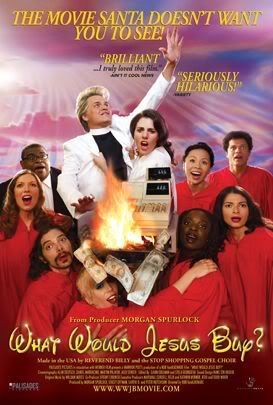
You can watch a trailer and the heart of Rev. Billy on youtube.
Not that I don't struggle with stuff, technolust, and such, but until we are willing to honestly deal with the greater issue of consumerism then being organic and green are secondary issues that we'll use to make ourselves feel better.
If you've made it to the end, then maybe you'd be up for a challenge. Click and play "Consumer Consequences" and see if the life you are living would be sustainable if everyone lived the way you do. The results may shock, anger, or embarrass you, but hopefully engender sustainable change in your life.
Look I agree that being "green" and buying "organic" are good things, but come on, you can get organic t-shirts and shoes! Not that I don't think we should be taking steps toward making our lives more sustainable and healthier in the USA, heck Jesus' parents were green :)
Here's the problem I think. Being green, environmental, and even organic are ways in which we can hide behind the real problem, all the while assuaging our guilt. So what's the real problem? Consumerism: You want it? Buy it. Oh, but buy it green or organic, but still buy it.
That's why, along with my friend Adam, I'm excited about this:
You can watch a trailer and the heart of Rev. Billy on youtube.
Not that I don't struggle with stuff, technolust, and such, but until we are willing to honestly deal with the greater issue of consumerism then being organic and green are secondary issues that we'll use to make ourselves feel better.
If you've made it to the end, then maybe you'd be up for a challenge. Click and play "Consumer Consequences" and see if the life you are living would be sustainable if everyone lived the way you do. The results may shock, anger, or embarrass you, but hopefully engender sustainable change in your life.
January 20, 2008
The Intimate Truth on Objective Truth, Pt. 2

In continuing to reveal the intimate truth on objective truth, we continue our discussion on all things truth, objective, and relational today. Don't miss part 1, before continuing into this series.
Thomas Kuhn in The Structure of Scientific Revolutions argues that no scientific, objective truth exists apart from value assessments and a person's perspective. All truth is colored by a person's commitments, experiences, and enculturation. You don't have to listen carefully to hear the tides of relativity washing onto the shore of objectivity. Even classicist professor Allan Bloom's famous "objective" statement on relativity is a relative statement:
“There is one thing a professor can be absolutely certain of, almost every student entering into the university believes, or says he believes, that truth is relative.”This statement is made relative by his biases, culture, and commitments. As a white male who had a bad experience teaching the classics in the '60's at Cornell, Bloom chose to ignore gender inclusive language by referring to speak generally of his students as "he" thus completely ignoring the feminist movement of the 60's. Also, with the rise of multiculturalism and new literature the classics fell on hard times, or at least lost the prestige Bloom felt they deserved.
Maybe this relative statement reveals that in our exploration for truth we just have to be "more" objective by submitting "more" to the primacy of reason. The answer to relativity is pure, objective reason right? We believe that all our commitments will be eclipsed in the light of reason. Reason trumps all other commitments. No!
In the Scripture when a person places their complete unadulterated trust or commitment in anything else than God for truth, life, worship, anything, its called idolatry. Yet, what we've failed to recognize is that reason has flown under the radar for too long as an idol. We don't recognize that the commitment to reason is just that, a commitment with no more a rational base than any other commitment whether to tradition, culture, or God.
Certainly humans can be committed to other things besides God such as environmentalism, but to place that thing over commitment to Christ is sin. In searching for truth, our first commitment must be to Christ, not rationality. Truth is not found in objectivity, but relational fidelity. Thus when we allow final, authoritative hegemony of one tradition- the tradition of rationality- all other traditions we are in relation to are diminished or blurred.
Truth is much more holistic than objectivity and reason alone allows. Truth is best known when we are faithful to our relative perspectives while seeking intimate relation to this world, to God, to others, to whatever we are seeking to know.
The Greatness of Men
Some men are great, others we call great to massage the false facades of our culture so that our dreams and interests don't seem as vain as they truly are. Some might call Tom Brady of the NE Patriots legendary, a success story, a man of greatness. Why? Maybe because he has 3 SuperBowl Rings, along with many cultural accolades (Esquire- Best Dressed Celeb; People- "Top 50 Most Beautiful"), while dating supermodel Gisele Bundchen. Yet, as the video below, in a moment of transparency in an interview with "60 Minutes" Brady admits that he's not fulfilled. "There's gotta be something more to life.
"
Of course today, we celebrate the youngest recipient of the Nobel Peace Prize: Martin Luther King Jr. In celebrating the birth of Dr. King, we in turn are celebrating the cause for his dreams, the catalyst for change in a world filled with segregated hate: the crucified and resurrected Christ. It was this hope that gave MLK Jr. the imagination and audacity to proclaim these words in his Nobel Peace Prize,
"
Of course today, we celebrate the youngest recipient of the Nobel Peace Prize: Martin Luther King Jr. In celebrating the birth of Dr. King, we in turn are celebrating the cause for his dreams, the catalyst for change in a world filled with segregated hate: the crucified and resurrected Christ. It was this hope that gave MLK Jr. the imagination and audacity to proclaim these words in his Nobel Peace Prize,
"I accept this award today with an abiding faith in America and an audacious faith in the future of mankind. I refuse to accept despair as the final response to the ambiguities of history. I refuse to accept the idea that the "isness" of man's present nature makes him morally incapable of reaching up for the eternal "oughtness" that forever confronts him. I refuse to accept the idea that man is mere flotsam and jetsam in the river of life, unable to influence the unfolding events which surround him. I refuse to accept the view that mankind is so tragically bound to the starless midnight of racism and war that the bright daybreak of peace and brotherhood can never become a reality. I refuse to accept the cynical notion that nation after nation must spiral down a militaristic stairway into the hell of thermonuclear destruction. I believe that unarmed truth and unconditional love will have the final word in reality. This is why right, temporarily defeated, is stronger than evil triumphant."These are the words of a truly great man, inspired by a truly great God.
January 18, 2008
Dawkins, not too different from the pew goer?
 Richard Dawkins is one the most brilliant scholars of our time, but that's not what makes him similar to many people who gather together on Sundays claiming themselves "Christian."
For those who may not know Dawkins, the title of this post should shock (okay, maybe not shock) you a little because he is one of the strongest voices in contemporary atheism. His The God Delusion has sold over 1.5 million copies, not bad for a book published in 2006.
So what makes your average pew goer similar to Dawkins? Folk religion. This BBC news story reveals that Dawkins not only does not want to purge Christianity from the UK, but he enjoys singing Christmas carols. Dawkins is quoted saying, "If there's any threat these sort of things, I think you will find it comes from rival religions and not from atheists."
Although overstated, I do think there are people who file in the door on Sunday morning because they "enjoy singing carols" in a sense, but not much else. Furthermore, we too often blame others, especially other religions for the weaknesses of the church or for the attacks on Christianity. Why take responsibility and try to... I don't know, repent and change, when you can blame others?
As time progresses in this country and the West, Christianity will more and more become a folk religion (which it already has for some) providing meaning, rituals, and holidays for our lives; but no real transformation or witness. To that I say our churches are full of atheists.
January 17, 2008
The Intimate Truth on Objective Truth, Pt. 1

Truth, how do we know it? In a recent discussion in class about history, I stated that all histories are subjective renderings of an author's perspective on a time, place, situation, personality(s), etc. Often, when I state such claims, that objective truth is not possible, I'm confronted with numerable remarks. The strongest argument I hear I think is that we must not lose out quest for objectivity in spite of subjectivity as if there is a middle way.
But I believe that a holistic view of truth must abandon objective truth claims. Before diving deep into more particularities of my argument, let me make some general statements about truth. The objective project seeks truth as distant, abstract, and universal (or absolute).
But is this the presentation of truth in the Scripture? In proverbs lady truth stands in the streets hollering for people's attention. Overall, the picture in the Bible of truth is one of a decidedly personal, relational, and social construct.
As a matter of fact, what most modern Bible translation render as "faithful," the hebrew word "emeth" in the KJV was translated as "truth."
To know truth is a matter of covenant fidelity. Psalm 85 claims that when God comes to Israel (vs. 9) then love and truth will meet, and truth will spring up from the ground . For the prophet Hosea, the lack of truth meant not error, but bloodshed.
Think about a marriage with no truth or very little. The end result is a broken relationship, divorce. So, the biblical ideals of truth as covenant faithfulness and relationality render the abstract and distant ideas of truth as meaningless. Truth then is fleshed out in sociocultural, political, and economic relations much the same way faith fleshes itself in practice.
January 15, 2008
Spring Semester Starts

The spring semester has started. I know, I know, I haven't been on this thing for months, well basically since last semester. I'm hoping to get back into writing on here more about life, ministry, faith, and theology.
Above are basically the books I'll be using for this semester minus a few. I'm really look forward to this semester and the oncoming summer in which I'll be going to India for 4 weeks. Once I return I'll be finishing my semester with my mentorship at a local ministry.
My class schedule looks to be challenging but really good. I'm taking "The Missional Church" where we're studying the missional nature of the church. Each person in class is reading one person or movement and bringing that perspective to class on the nature, structure, and theology of the church. As you can see from the above pic, I'm Jurgen Moltmann.
I'm also taking "Religion & Worldviews," "Social Justice," and "The Story of Christian Mission."
October 21, 2007

September 18, 2007
Fall '07 Semester in Swing
The fall semester is full throttle right now, so I thought I would take some time to share what I'm taking and reading.
Principles, Methods, and Strategies: I think that anyone desiring to be involved in local ministry here in the states should be in the mission concentration at Truett. It's only here that we read books that really get you to think, and our discussion usually take place outside of the box, teetering on revolution every day. I'm enjoying this class much more than I originally thought I would. Outside of some articles on missionary roles, we are reading:
John Nevius- The Planting and Developing of Missionary Churches
Jonathan Bonk- Missions and Money
Thomas Kuhn- The Structure of Scientific Revolutions
Roland Allen- The Spontaneous Expansion of the Church
Biblical Themes and Theology: in this class we are picking up a new hermeneutic for reading the Bible- primarily missional. I'm preparing a paper on "Reconciling Economics," a biblical look at reconciliation and economics.
Jonathan Wright- The Mission of God
David Smith- Mission After Christendom
Harry Boer- Pentecost and Missions
TnT 3 (Texts and Traditions): This class is one of the reasons I came to Truett. Although, I must admit that Truett teaches theology historically by reading the primary sources, I am disappointed that my teacher this semester is a systematic theologian. Therefore, we are reading the primary sources, but these sources are structured around the Apostles Creed.
Karl Barth- Dogmatics in Outline
Wolfhart Pannenberg- The Apostles' Creed in Light of Todays Questions
Joseph Ratzinger- Introduction to Christianity
Hans Kung- Credo
Roger Can Harn- Exploring & Proclaiming the Apostles' Creed
we are also reading some Moltmann, Schleiermacher, Achetemeier, and Zannoni
Scriptures 4- Somehow in one semester we are going to cover the New Testament from Romans to Revelation. This class is reading intensive to say the least. I am doing my research paper on Paul and his relationship to Israel in Rom. 9-11.
Raymond Brown- An Intro to the New Testament
Meeks and Fitzgerald- Norton's The Writings of St. Paul
David Horrell- An Intro to the Study of Paul
Jouette Bassler- Navigating Paul
Richard Bauckham- The Theology of the Book of Revelation
As you can tell, this semester is quite reading intensive. With that said, I do have a few other reads I am trying to get through for myself that may or may not happen.
Levitt & Dubner- Freakonomics: A Rogue Economist Explores the Hidden Side of Everything
Either Thomas Friedman' The World is Flat or The Lexus and The Olive Tree
Since are not reading much of Multmann, I plan on working through one of these on my book shelf: The Crucified God, Theology of Hope, or The Trinity and the Kingdom
And lastly, maybe to pick up for our Bible Study- Walsh & Keesmatt- Colossians Remixed
Principles, Methods, and Strategies: I think that anyone desiring to be involved in local ministry here in the states should be in the mission concentration at Truett. It's only here that we read books that really get you to think, and our discussion usually take place outside of the box, teetering on revolution every day. I'm enjoying this class much more than I originally thought I would. Outside of some articles on missionary roles, we are reading:
John Nevius- The Planting and Developing of Missionary Churches
Jonathan Bonk- Missions and Money
Thomas Kuhn- The Structure of Scientific Revolutions
Roland Allen- The Spontaneous Expansion of the Church
Biblical Themes and Theology: in this class we are picking up a new hermeneutic for reading the Bible- primarily missional. I'm preparing a paper on "Reconciling Economics," a biblical look at reconciliation and economics.
Jonathan Wright- The Mission of God
David Smith- Mission After Christendom
Harry Boer- Pentecost and Missions
TnT 3 (Texts and Traditions): This class is one of the reasons I came to Truett. Although, I must admit that Truett teaches theology historically by reading the primary sources, I am disappointed that my teacher this semester is a systematic theologian. Therefore, we are reading the primary sources, but these sources are structured around the Apostles Creed.
Karl Barth- Dogmatics in Outline
Wolfhart Pannenberg- The Apostles' Creed in Light of Todays Questions
Joseph Ratzinger- Introduction to Christianity
Hans Kung- Credo
Roger Can Harn- Exploring & Proclaiming the Apostles' Creed
we are also reading some Moltmann, Schleiermacher, Achetemeier, and Zannoni
Scriptures 4- Somehow in one semester we are going to cover the New Testament from Romans to Revelation. This class is reading intensive to say the least. I am doing my research paper on Paul and his relationship to Israel in Rom. 9-11.
Raymond Brown- An Intro to the New Testament
Meeks and Fitzgerald- Norton's The Writings of St. Paul
David Horrell- An Intro to the Study of Paul
Jouette Bassler- Navigating Paul
Richard Bauckham- The Theology of the Book of Revelation
As you can tell, this semester is quite reading intensive. With that said, I do have a few other reads I am trying to get through for myself that may or may not happen.
Levitt & Dubner- Freakonomics: A Rogue Economist Explores the Hidden Side of Everything
Either Thomas Friedman' The World is Flat or The Lexus and The Olive Tree
Since are not reading much of Multmann, I plan on working through one of these on my book shelf: The Crucified God, Theology of Hope, or The Trinity and the Kingdom
And lastly, maybe to pick up for our Bible Study- Walsh & Keesmatt- Colossians Remixed
September 17, 2007
Worship as Solidarity
I've been mulling over worship the last few weeks, ever since Brian McLaren visited Truett to talk about the challenge of radio orthodoxy. In the hour discussion, Brian shared some lyrics from this song.
Then a week later I read in Jonathan Wright's The Mission of God that mission creates praise and vice versa. And tonight I read Sally Morgenthaler's article over at Allelon. She sums up her experience with worship evangelism, which she can be rightly called the initiator or innovator of this movement. In grief, she admits the church has become narcissistic and misuses worship as the chief means of getting people inside the walls of the church building. As she described the perception of a nonbeliever experiencing this worship evangelism, I was struck by this quote,
Most nonbelievers will find Sunday morning worship at most churches irrelevant and probably annoying. Who can fit into this picture of continual happiness and praise? Is there any room for the suffering? Is there any room for the pain of the world? Is there any room for the grief and tears shed over those who don't yet know God?
So, what do we do with Sunday morning worship? Do away with it altogether? No, connect it with reality. We realize that worship is a time for Christians to be transformed for God's mission, not a time for happiness or comfort. This should be a time of discomfort sometimes, lamenting the pain in the world as well as the weakness of the church to meet it. Then, and only then will true praise for God flow, since it is here that we meet God. In our weakness, seeking to find him in his strenght among our neighbors, communities, and nonchurched.
Then a week later I read in Jonathan Wright's The Mission of God that mission creates praise and vice versa. And tonight I read Sally Morgenthaler's article over at Allelon. She sums up her experience with worship evangelism, which she can be rightly called the initiator or innovator of this movement. In grief, she admits the church has become narcissistic and misuses worship as the chief means of getting people inside the walls of the church building. As she described the perception of a nonbeliever experiencing this worship evangelism, I was struck by this quote,
No sad songs. No angry songs. Songs about desperation, but none about despair. Worship for the perfect. The already arrived. The good-looking, inoffensive, and nice. No wonder the unchurched aren't interested.The church has become insulated from reality by its own worship. In Romans 12, Paul urges Christians to worship. He does not say that we should gather on one single day and allow nonbelievers to gather to us. He does not say that we should spend all our time, effort, and money on a single event for adore and praise God. He does not say that we should seek relevant songs or tunes. No, instead Paul says that worship by being transformed, living our lives as a sacrifice. A sacrifice! Now, if you allow me to pull this out of the "spiritual" talk of daily quiet times or prayer times into reality; I think Paul is saying that we must go into the world, into our communities, into our neighborhoods and seek solidarity. For most of us, that means opening ourselves to the grief and suffering of those who don't have their lives together. That means giving up our self-referential, self-sustaining, narcissistic, consumeristic lifestyles in order that others may be experience wholeness.
Most nonbelievers will find Sunday morning worship at most churches irrelevant and probably annoying. Who can fit into this picture of continual happiness and praise? Is there any room for the suffering? Is there any room for the pain of the world? Is there any room for the grief and tears shed over those who don't yet know God?
So, what do we do with Sunday morning worship? Do away with it altogether? No, connect it with reality. We realize that worship is a time for Christians to be transformed for God's mission, not a time for happiness or comfort. This should be a time of discomfort sometimes, lamenting the pain in the world as well as the weakness of the church to meet it. Then, and only then will true praise for God flow, since it is here that we meet God. In our weakness, seeking to find him in his strenght among our neighbors, communities, and nonchurched.
Subscribe to:
Posts (Atom)


 Posts
Posts


