August 16, 2008


Brilliant Quotes or What a Genius Says vol. iii
"The only thing that interferes with my learning is my education."
"We can't solve problems by using the same kind of thinking we used when we created them."
"The important thing is not to stop questioning. Curiosity has its own reason for existing."
"We can't solve problems by using the same kind of thinking we used when we created them."
"The important thing is not to stop questioning. Curiosity has its own reason for existing."
August 14, 2008
The Real Work is Humbling
God sets out upon the humiliating path of reconciliation and thereby pronounces the world free. God wills to be guilty of our sin, and takes over the punishment and suffering sin has brought upon us. God answers for godlessness, love for hatred, the saint for the sinner. Now there is no godlessness, no hatred, no sin which God has not carried, suffered, and atoned. Now there is no reality, no world that is not reconciled and in peace with God. God did this in the beloved son Jesus Christ.
- Dietrich Bonhoeffer
Meditations on the Cross via
- Dietrich Bonhoeffer
Meditations on the Cross via
Setting Limits, Fighting Heresy
 Although I finished this post a few weeks ago, I've had a hard time posting it. I'll give the reason's afterwards, but here's the post in full:
"In discussing the historical Jesus, Bonhoeffer explains why critical christology is important. Not everything about Christ is comprehensible, but the work of critical christology is to limit the incomprehensible, thus it determines the boundaries of "what may not be said about Christ."
It certainly is important to figure out what we should not say about Christ, otherwise our faith truly is nothing. This does not mean of course that we must completely understand the questions of "who" or "how" Jesus, but it does give us categories for comprehending the God-man, incarnate one.
In our pluralistic society one of the dirty words has become heresy, which Bonhoeffer links to critical christology. "If critical christology is concerned with fixing limits, that means it is concerned with the concept of heresy."
Bonhoeffer's notes on heresy are helpful for understanding its role and why there is a need to point it out. I do recognize that heresy often arises from power struggles and can lead to paternalism, but there is still a need to recognize what cannot be said about Christ, the limits. Heresy thus "emerges from the fellowship of the Church and not from an absence of love." To love someone in a brotherly or sisterly way means to speak the truth in love, and "if I do not speak the truth, then I treat him like a heathen."
Here's the reasons I had a hard time posting:
1) Heresy can often and is often what the "winners" say it is, thus the history and theology written by the western church does not mean its the only correct theology. Our own neo-colonial attitude toward theology in the global South and East (read nonWestern) is that we have to guide and protect "them" from heresy. We must speak the truth in love, when in actuality we are speaking are perspective on truth. In actuality, the more loving thing to do is to allow them to have their heresies.
2) We have our own heresies, so we should let others have them too. If I recall, most Christians that I know would be called a heretic by someone (i.e. Joseph Ratzinger).
3) The idea I found most resonating with me from Bonhoeffer's thought is that heresy arises from the fellowship of the church. This is what we need, for the church global and local to be connected and united in its diversity. We must have boundaries, but boundaries do not exist for the sake of judgment but rather for love. Boundaries help us know as much what we are for as what we are against.
Brilliant Quotes or What a Genius Says vol. ii
"Anyone who has never made a mistake has never tried anything new."
"Everything should be made as simple as possible, but not simpler."
"Common sense is the collection of prejudices acquired by age eighteen."
"Everything should be made as simple as possible, but not simpler."
"Common sense is the collection of prejudices acquired by age eighteen."
Moltmann meet _______?
or Which Theologian are You? I'm mostly Moltmann, which I can understand, but Schleiermacher at 67%? I have to go back and think through the questions differently. I thought I did a good job of recognizing which theologian would go alongside which questions. Anyways, click on it and take the quiz, let me know who you come out to be.
| You scored as a Jürgen Moltmann | ||||||||||||||||||||||||||||||||||||||||
| The problem of evil is central to your thought, and only a crucified God can show that God is not indifferent to human suffering. Christian discipleship means identifying with suffering but also anticipating the new creation of all things that God will bring about. | ||||||||||||||||||||||||||||||||||||||||
|
August 13, 2008
Top 10 LifeHakcer Vid's
Learn how to buy a car, suck less at photoshop, get cheap batteries, make an awesome flashlight among other things here.
Bonhoeffer on the Sermon & Truth
 Continuing in my reading with Bonhoeffer I enjoyed his short exposition on preaching. The person of Christ exists in preaching. Humans words don't cloak the Word of God, "rather, God's Word has really entered into the humiliation of the words of men. Man's sermon is the Word of God, because God has freely bound himself and is bound to the words of men."
The role of the sermon as the Word of God is an idea that can be disconcerting. I often feel our churches often allow the preacher to become an authoritative figure towering over the congregation, thus disembodying the body of Christ. But to understand Bonhoeffer means that the sermon never stands over the body, but rather is shared within the body.
Truth is non-objectivistic for Bonhoeffer, which I was glad to read:
Truth is not something in itself, which rests for itself, but something that happens between two. Truth happens in community.I have struggled with the task of preaching in our culture. A culture that doesn't trust authoritative figures that pull objective truth from the sky (read: their ass), a participatory culture, and an entertained culture. But I was reminded this week about the power and reality of the spoken word, especially when it is the Word as Bonhoeffer would argue.
Because of the many facets of preaching, I like that Bonhoeffer calls the sermon "both the riches and the poverty of the church." Our broken, frail human words become the Word and "what is impossible for man and what God promises are the same."
I think I believe in preaching if the sermon is formed by the community, for that is where truth happens. The sermon must be a shared act of the church. I'm not sure what this means exactly in my context, but I think it means intertwining the people's narratives with God's, forming and informing the Scripture with the people and forming and informing the people with the Scripture.
Maybe preaching is the task of asking better questions. Maybe preaching is learning to have fluid conversations about faith and Jesus over shared food, a camp ground, and a car ride.
Do you think that preaching is a necessary tool for the church's proclamation of the gospel? What does the task of preaching look like in our culture?

August 12, 2008

August 11, 2008
Torn Curtain
Torn Curtain
by
John Frye
The sword cuts a deep gash in bloody flesh,
The holy curtain from top to bottom
on the Temple mount
rips, separates.
Two temples purposely damaged,
A Roman cross and the Holy of Holies change places
as God startles the planet.
Last deep breath of the Nazareth teacher
from a criminal’s planks
breathes life to the world.
A seasoned soldier, wearied by death,
sees, hears a human’s cry like no other,
declaring on the spot his disloyalty
to Caesar.
What a dangerous world with God roaming free!
What I am and What I am Not
Here's a short and helpful history of the emerging church by Alan Creech. I liked this paragraph:
"There is a good deal of good deep theological thought going on in this stream of the whole business. How these churches are "constructed" are flowing from deeper waters, I think. The rethinking of pulpit-pew preaching is not just about people being bored by that, but more about this being a very limited view of how the church functions as she meets together. There is more of a holistic view. In other words, there's not just Martin Luther and Zwingli to take into consideration, but also, and perhaps more, there is St. Ignatius of Antioch, Origen, Tertullian and Basil. There are the many monastic renewal movements starting in the 6th century and on through the middle ages. There is the deep and ancient tradition of Christian Mysticism which has been handed down and which still exists today in many Catholic monasteries. Perhaps St. Patrick and many of the Celtic missional monastic tradition could be mentioned as highly influential of this stream."Or check out this article on why "Christians s*ck" by Tom Davis, where he says things such as:
We might as well give God the middle finger. Outside of a tiny minority of Christians, we have become a self-centered group of priggish snobs.
In short, we s**k.
August 10, 2008
Silence & Confession, A Reflection on Bonhoeffer
 To kick off my study of Bonhoeffer, I've begun with Christ the Center. Already he has laid out some powerful ideas in just the introduction. The hinge of scholarship revolves around Christ for Bonhoeffer because Christ is the Word. But the study of christology does not revolve around the "how" question such as how is Christ God and man, but rather the "who?" questions.
So the very beginning of any scholarship begins not with what, why, or how, but "who?". The beauty in his existential thought reveals itself when he says that Christ is not known through his works as Schleiermacher proposes, but his works are known through the very person of Christ. Christ is known when he reveals himself in the noncompulsive silence of prayer.
In Life Together by Bonhoeffer, one of the most important aspects of community is confession; but I didn't quite understand why a Protestant theologian would emphasize confession so strongly until I read his analogy that in confessing our sins to one another we are authentically revealing ourselves. We cannot be forced to reveal ourselves, and neither can Christ.
As Filipina theologian Melba Maggay says:
Prayer is not a pious instrument by which we move God to baptize our enterprises; it is entering the strength of him who moves history and binds the powers that be. viaPrayer is not the place where we come to control Christ, but where Christ can if he wills to reveal himself and answer the question of "who?". The encounter with Christ is unavoidable since, as Bonhoeffer says, Christ is alive therefore "there are only two ways possible of encountering Jesus; man must die or he must put Jesus to death." Unfortunately, I believe the natural reaction of most of us is to put Christ to death.
I also wonder if Bonhoeffer isn't helping the church to understand how to be the listener when the other confesses their sins. Too often we act as if we are the forgivers or if our wise words can fix the person opening themselves to us, but maybe the most appropriate response is silence for in silence between two people Christ can speak or we can hear the words to repeat from the very source that defeats the powers that be.
We gain access to Christ in the "attempt to be in the place where the Person reveals himself in his own being, without any compulsion. That is the place of prayer to Christ. Only by the Word freely revealing himself is the Person of Christ available and with that also his work."
Arbuckle= Social Angst/ Depression/Loneliness Commentary
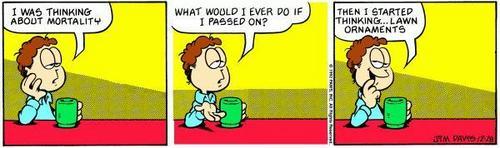
Something I discovered a few months ago that I've been meaning to share is this brilliant blog that takes Garfield out of the Garfield comics. Here's what the site says about itself:
Garfield Minus Garfield is a site dedicated to removing Garfield from the Garfield comic strips in order to reveal the existential angst of a certain young Mr. Jon Arbuckle. It is a journey deep into the mind of an isolated young everyman as he fights a losing battle against loneliness and depression in a quiet American suburb.Check it out!
August 7, 2008

August 6, 2008
A Protestant Saint?
Since leaving seminary and beginning my work as a pastoral resident I've been asking myself the question of how I'm going to engage theology while remaining faithful to the task at hand, my job. My fear is that I'll leave behind something I love (theology) in the midst of the craziness of life OR that trying to engage in a continual study of some kind will distract me from my work.
To experiment I thought I would study Bonhoeffer's works and thought. I figured of all the choices out there, Bonhoeffer would be a strong friend in my ministry setting. I'm not sure how this will work since I'm also coupling my mentoring to finish my M.Div. this fall to graduate in December with my residency. With mentoring I'll be reading 6 or so books this fall, which isn't alot except that I'm also trying to figure out work.
I've already read a few books on or by Bonhoeffer: The Cost of Discipleship, Life Together, & Psalms by Bonhoeffer and The Bonhoeffer Phenomenon by Stephen R. Haynes. Inspired by a few friends who have recently read or are reading Bonhoeffer I'l be picking up Ethics, Sanctorum Communio, Letters and Papers from Prison, Bethge's timeless biography and I'm currently reading Christ the Center. I'll probably return to The Cost of Discipleship a few times, since I haven't read it since college.
There are many reasons why to choose Bonhoeffer, but his context and death in a Nazi concentration camp, his life, and his Christocentric theology that pushes for church reform are just a few.
Picking up where we (I) left off...
Well, the time has come to finally blow the dust off my keyboard and get back to blogging. Okay, maybe the dust hasn't collected on my laptop, but it was nice taking a break from blogging especially because since coming back from India this summer has been a bit crazy. I realized that I picked up some readers during my India trip, but probably lost them all so to my two faithful readers I'm back!
I'm not sure where to take this blog now that I'm entering a new season in life. I'll probably be posting more on my failure and the messiness of life transition for a while, until I can - if I can- get a hold on things post-seminary. For sure I'll be posting thoughts on what I'm reading, giving some reviews, and talking through my context here at FBC Austin as the Pastoral Resident.
It's good to find some routine again, especially since I feel like I'm coming out of reverse culture shock. I'm finding being an American Christian, or better Christ follower, an interesting enterprise again. Hopefully I'll be able to post up a few things on what I'm reading, watching, and what has been going since I got back.
Subscribe to:
Posts (Atom)


 Posts


