September 29, 2008

ACL Fest '08


My first thought is why haven't I been to more of these! Even though there were alot of complaints about the lineup not being as strong as in past festivals, I really enjoyed my two days in Zilker Park. So apparently this is one of the reasons to love Austin and overall I thought it was great.

Here's a list of the bands I saw (I missed Friday completely):
Saturday:
Man Man/ CSS/ Erykah Badu/ City and Colour/ MGMT/ Spiritualized/ ConorOberst and the Mystic Valley Band/ Iron and Wine/ Robert Plant & Alison Krauss/ Beck
Sunday: Flyleaf/ Against Me/ Colour Revolt/ Okkervil River/ Raconteurs/ Gnarls Barkley/ Foo Fighters

I had a blast at the Foo Fighters venue. My wife and I crammed in with the first clump of about 150 people near the stage of about 60,000, which made all the difference. I also really enjoyed Plant/Krauss, Iron and Wine, Colour Revolt, Spiritualized, Beck, Raconteurs, and City and Colour.

September 21, 2008

Ended up Nicely

This weekend was pretty productive for some "around the house" type duties. Although we still need a new vacuum cleaner (ours of 5 years died a violent and smelly death)...(I guess this is what happens when you own a husky), I did get a few things done I've been meaning to for a while.

1) I made several hundred dollars from cleaning out some spare parts from the garage and posting them on ebay. Now I have a cleaner garage and some cash in my pocket.

2) I put a new speed control sensor and o2 sensor in the 5.0. I drove the beast around for about half an hour. There are still some kinks to get worked out, but with some new cash in my pocket I think I'll finally just put it in a shop.

3) My favorite and most ghetto activity of the weekend. Dropped about 80 bucks on a brand new paint job. That's right 80 bucks! Well, my 4 banger Mustang is a piece and has (no wait, had) many rust spots. These cars keep their value, but their only worth their body and chassis shape. Thus, I spent several hours sanding and grinding off rust from the car. With the bare metal exposed, I rattle canned some Krylon Rust prevention primer with zinc, then some Krylon semi-black paint. My entire afternoon and evening was consumed by this job, but now I must say that the semi-flat black Mustang looks much better then the rust and faded black (pic's forthcoming). You can take me out of the ghetto...

September 20, 2008

Rollins & Bonhoeffer in Coversation

"The argument can be made naming church is never really naming church but only our understanding of church." *I have taken the liberty in the quotations from Rollins to replace "God" with "church" in light of Bonhoeffer's discussion on the church as revelation.

The funny thing about revelation for Rollins is that although it may be the opposite of concealment, it still has concealment built into it. He tests his case by showing the various and even contradictory forms of God revealed throughout the testimony of the Scriptures do not paint a complete or clear picture of God for every case. "Hence, revelation ought not to be thought of either as that which makes church known or that which leaves church unknown but rather as the overpowering light that renders church known as unknown."

Rollins states, "Consequently, we do not do theology (church) but rather are overcome and transformed by it; we do not master it, but are mastered by it." We must be willing to give up our talk about God and the church, or hold it loosely for the church to overcome us. I'm concerned that the emerging church conversation has become a place to master church, instead of be mastered by it. We are grateful and appreciated or generous enough to appreciate the ancient church, but too bitter to do the same for the modern church.

In line with Rollins' thinking about God, the church is not an object to be studied, replicated, etc. Rather, she is a subject to be in faithful relationship, understood not through study but experience, an experience with reality that transforms reality, not describes it.

Thus, God or the church as revelation can be met through the a/theistic religious community or church. Instead of a gross fundamentalism that excludes all other interpretations of reality that differ from one's own, "the a/theistic approach can be seen as a form of disbelieving what one believes, or rather believing in church, while remaining dubious concerning what one beleives about church."

September 19, 2008

That was weird

I just checked out Mark Driscoll's new site. Huh, well, it was definitely weird.

September 17, 2008

Bonhoeffer & Rollins in Conversation

In his PhD. dissertation, Sanctorum Communio (SC) Bonhoeffer (DB) writes a sociological/theological account of the church and community. Instead of arguing for a narrow individualism, DB argues that humans exist as communal beings. This does not take away from the uniqueness of individuals, but rather highlights it.
The individual personal spirit lives solely by virtue of sociality, and the ‘social spirit’ becomes real only in individual embodiment. (SC)
DB then explicates a very helpful understanding of sin as both individual and communal so that guilt lies within both realms evenly (which I believe is a very important theological statement to make).

Thus, sin is not a biological problem, but a societal and individual problem. Every individual falls into sin, thus making the human race fall into sin anew. So here is where the church comes in:
It is 'Adam', a collective person who can only be superceded by the collective person 'Christ existing as church-community.' (SC)
The reality of the church is to be either denied or trusted, because it is by nature revelation. By nature man is capable of sin, not church which is understood by Bonhoeffer to be the presence of Christ.
Thus, everyone beomces guilty by their own strength and fault, because they themselves are Adam; each person, however, is reconciled apart from their own strength and merit, because they themselves are not Christ. (SC)
These thought by Bonhoeffer will be helpful when I bring Pete Rollins into the conversation. We'll need to remember that the church when it exists, exists not by the actions of 'Adam', but instead by the revelation of Christ, the church is Christ and Christ is the church. There is much that can be said here, but our focus is that whatever may be said of the church, it is the real presence of God in the world through the revelation of God himself.

Let's Eat Plastic!

This isn't an invitation, but rather a reality. Check out this scary swarm of plastic garbage floating in the middle of the Pacific...oh, did I mention that its twice the size of Texas!!! For those think that fish eating plastic wouldn't effect us, why do you think there are more cancers and more cancer now then ever?

September 14, 2008

Emerging Church Fundamentalism

I wonder if the way the church is talked about in the emerging missional church (EMC) conversation is related to fundamentalism. Because the emerging church can be complex and multifaceted, I'm not necessarily talking about any one thing. As a matter of fact I'm not talking about a thing or doctrine at all, but rather a way of thinking. Truly that's what fundamentalism is, a way of thinking (as noted by Pete Rollins in How (not) to Speak of God).

Rollins describes fundamentalism as holding a "belief system in such a way that it mutually excludes all other systems, rejecting other views in direct proportion to how much they differ from one's own." From my own experience in the EMC conversation, it seems that many who are going through the deconstruction process or are simply in the conversation can be the most excluding group of people when it comes to ecclesiology, writing off in a reactionary fashion any forms of the modern church.

Could it be possible that we've been so careful to have a generous orthodoxy, that we cannot have a generous ecclesiology toward the churches and institutions that have parented our faith. In a forthcoming post I'm going to bring together the thought of Bonhoeffer who claims the church is revelation and thus Christ and Peter Rollins who claims that Christians must be a/theists and "not master theology but be mastered by it." Or maybe that Christians must not master the church, but be mastered by it.

September 13, 2008

Graphic Tax Cuts

Proposed tax cuts from blue and red camps. via.

Check the link out to see the graph in more detail. This tool was helpful for me to see the reality, especially that the top richest few will benefit the most from the dem's. Interesting.

Books in the Political Season

Amazon has a really interesting way of tracking the "redness" or "blueness" of book buying. Check it out.

September 12, 2008

Holistic Christianity: Bonheoffer

Our being Christian today will be limited to two things: prayer and righteous action among humanity.

- Dietrich Bonhoeffer

via.

September 11, 2008

Theology, please conversate with Science!

When theology, biblical studies, and science are not in conversation (which they must always be to be a responsible theologian), then sites and folks like this do things like this:
Please take the time and read the material provided on this website. We are here to help. If you or a loved one is suffering from Homosexuality don't hesitate to send them our way. Please Email us with any questions or thoughts.
(from godhatesfags.com, their new site lovegodsway.com)
Check out this article on brain development and homosexuality. I'll declare up front I don't know where I stand on the issue of homosexuality, but I can tell you two things. We Christians MUST address the issue in humility and must change the way we have addressed the issue in the past (or should I say present). Secondly, we in our humility we must listen to other voices on this issue. For me, it is important whether or not homosexuals are born gay or not. If they are or at least some are then this is a classic case of our theology needing to listen to science.

What happens when we ignore science? Well, ask Galileo who was thrown into prison by the church for supporting Copernicus' claim that the planets revolve around the sun, not the earth and the pope.

In their study of 25 straight men, 25 straight women, 20 gay men, and 20 gay women, the neurologists at Karolinska Institute in Stockholm, Sweden, found that
Savic was able to demonstrate highly statistically significant differences between straight and gay brains. Gay and lesbian brains more closely resembled the brains of straight volunteers of the opposite sex than the brains of heterosexual members of the same sex.
and
Although Savic admits that her study cannot distinguish between genetic or prenatal intrauterine environmental changes, such as relative differences in sex hormone levels, her studies do suggest that our sexual preferences are, at least in large part, determined by the time of birth.
Interesting indeed. Read the rest.

Oh SNAP

September 10, 2008

7 Deadly Sins

For anyone in politics and the church, I bring you Gandhi's 7 deadly sins:
  • Wealth without Work
  • Pleasure without Conscience
  • Science without Humanity
  • Knowledge without Character (interesting, one of my favorite quotes from MLK Jr. is "knowledge plus character equals education")
  • Politics without Principle
  • Commerce without Morality
  • Worship without Sacrifice
via

September 5, 2008

Authority in the Church

Following conversation sparked from some thoughts on Bonhoeffer and Adam's thoughts, I've been thinking about authority and pastoral identity. As a postmodern, I'm inclined to distrust and critique the modern creation known as the "pastor." Why? There are many reasons, but here's only a few.

Many pastors hold so much authority that they are held to higher standards than normal people. Catch that, we're even comfortable dislocating the pastor from the congregation, the lay people and the pastor, there again arises the sacred/secular divide. It seems that pastors, because they are given the spotlight can represent all that is bad or wrong with the church or must hold all that is good and right with it. This is simply too much responsibility for an individual, but rather authority must be carried in community.

Here's where I take issue with theologians like Moltmann who over emphasize the democratic nature of the church so much that any semblance of an authoritarian figure is bad. In reality our churches are full of busy people, thus there must be room for the church to appoint certain people to take care of ministerial and administrative duties.

Good Reformationists would say that authority lies in the Scripture, but the question is still who has the authority to interpret the Scripture: the pastor or people? I see a need for a healthy interplay between both. All communities will have leaders that hold more authority in the congregation, and it is healthy only when that person or group of persons is given that authority by the community. Authority ultimately lies in Christ working though the Holy Spirit represented by the whole of the church. Thus, not only must there be interplay between leaders and the community, but there must be interplay between communities of different theological, geographical, political, and socio-economic difference.

What are your thoughts on authority in the church, especially in light of "pastoral" identity?

September 4, 2008

August 31, 2008

Change in 2008? Yeah, but No

I've really appreciated some voices I've come across lately that are able to look into what is going on in American politics and speak reality into the mire, thus I'm posting Eliacin Rosario-Cruz's post in full:

"It is not just about the last 8 years.

To assume that change will happen by just focusing on November 4 is a naive view of history and a adolescent understanding of democracy. On Nov. 4 people will elect a new administrator in the same system of power that perpetuates itself. There are bigger systems than the executive and the legislative at play here. On Nov. 4 the imbalanced of structure of representative “democracy” is will not be on the ballot. Nor there will be a vote about the position of hierarchical power of the wealthy elite (individual, coorporations, international trade organizations) whom live and operate outside national politics but benefit economically from it. There will be no option to vote about the myth of the USA as patriarchal leader and police of the world. These and more are some of the structures and foundations that need to be strongly questioned and challenge in order to bring real change.

Don’t get me wrong, I am fortunate to share with my daughter the historic time of having a black man and a woman running for office. Like many others I get excited by many of the statements and political platform from Senator Barack Obama, but that is not enough for me to believe there will be more than aesthetic modifications. While I think there will be certain alterations to the pattern of politics, economics and social services we’ve see in the past 8 years, that will not be enough to call it change.

The following is a brief list of USA military interventions in the Latin America. As you can see the list start way before year 2000. The same myths that fueled these and many other interventions still fueling the national identity of USA to this day.

Argentina 1890 Troops Buenos Aires interests protected
Chile 1891 Troops Marines clash with nationalist rebels
Haiti 1891 Troops Black workers revolt on U.S.-claimed Navassa Island defeated
Nicaragua 1894 Troops Month-long occupation of Bluefields
Panama 1895 Naval, troops Marines land in Colombian province
Nicaragua 1896 Troops Marines land in port of Corinto
Cuba 1898- Naval, troops Seized from Spain, U.S. still holds Navy base at Guantanamo
Puerto Rico 1898- Naval, troops Seized from Spain, occupation continues
Nicaragua 1898 Troops Marines land at port of San Juan del Sur
Nicaragua 1899 Troops Marines land at port of Bluefields
Honduras 1903 Troops Marines intervene in revolution
Dominican Republic 1903-04 Troops U.S. interests protected in Revolution
Cuba 1906-09 Troops Marines land in democratic election
Nicaragua 1907 Troops “Dollar Diplomacy” protectorate set up
Honduras 1907 Troops Marines land during war with Nicaragua
Panama 1908 Troops Marines intervene in election contest
Nicaragua 1910 Troops Marines land in Bluefields and Corinto
Honduras 1911 Troops U.S. interests protected in civil war
Cuba 1912 Troops U.S. interests protected in Havana
Panama 1912 Troops Marines land during heated election
Honduras 1912 Troops Marines protect U.S. economic interests
Nicaragua 1912-33 Troops, bombing 20-year occupation, fought guerrillas
Mexico 1913 Naval Americans evacuated during revolution
Dominican Republic 1914 Naval Fight with rebels over Santo Domingo
Mexico 1914-18 Naval, troops Series of interventions against nationalists
Haiti 1914-34 Troops, bombing 19-year occupation after revolts
Dominican Republic 1916-24 Troops 8-year Marine occupation
Cuba 1917-33 Troops Military occupation, economic protectorate
Panama 1918-20 Troops “Police duty” during unrest after elections
Honduras 1919 Troops Marines land during election campaign
Guatemala 1920 Troops 2-week intervention against unionists
Costa Rica 1921 Troops
Panama 1921 Troops
Honduras 1924-25 Troops Landed twice during election strife
Panama 1925 Troops Marines suppress general strike
El Salvador 1932 Naval Warships sent during Faribundo Marti revolt
Uruguay 1947 Nuclear threat Bombers deployed as show of strength
Puerto Rico 1950 Command operation Independence rebellion crushed in Ponce
Guatemala 1954-? Command operation, bombing, nuclear threat CIA directs exile invasion and coup d’Etat after newly elected government nationalizes unused U.S.’s United Fruit Company lands; bombers based in Nicaragua; long-term result: 200,000 murdered
Panama 1958 Troops Flag protests erupt into confrontation
Cuba 1961 Command operation CIA-directed exile invasion fails
Cuba 1962 Nuclear threat, naval Blockade during missile crisis; near-war with Soviet Union
Panama 1964 Troops Panamanians shot for urging canal’s return
Dominican Republic 1965-66 Troops, bombing Marines land during election campaign
Guatemala 1966-67 Command operation Green Berets intervene against rebels
Chile 1973 Command operation CIA-backed coup ousts democratically elected Marxist president
El Salvador 1981-92 Command operation, troops Advisors, overflights aid anti-rebel war, soldiers briefly involved in hostage clash; long-term result: 75,000 murdered and destruction of popular movement
Nicaragua 1981-90 Command operation, naval CIA directs exile (Contra) invasions, plants harbor mines against revolution; result: 50,000 murdered
Honduras 1982-90 Troops Maneuvers help build bases near borders
Grenada 1983-84 Troops, bombing Invasion four years after revolution
Bolivia 1987 Troops Army assists raids on cocaine region
Panama 1989 Troops, bombing Nationalist government ousted by 27,000 soldiers, leaders arrested, 2000+ killed
Haiti 1994-95 Troops, naval Blockade against military government; troops restore President Aristide to office three years after coup
Venezuela 2002 Command operation Failed coup attempt to remove left-populist president Hugo Chavez
Haiti 2004- Troops Removal of democratically elected President Aristide; troops occupy country

August 26, 2008

Setting Boundaries, the Importance of Heresy

Although I finished this post a few weeks ago, I've had a hard time posting it. I'll give the reason's afterwards, but here's the post in full:

"In discussing the historical Jesus, Bonhoeffer explains why critical christology is important. Not everything about Christ is comprehensible, but the work of critical christology is to limit the incomprehensible, thus it determines the boundaries of "what may not be said about Christ."

It certainly is important to figure out what we should not say about Christ, otherwise our faith truly is nothing. This does not mean of course that we must completely understand the questions of "who" or "how" Jesus, but it does give us categories for comprehending the God-man, incarnate one.

In our pluralistic society one of the dirty words has become heresy, which Bonhoeffer links to critical christology. "If critical christology is concerned with fixing limits, that means it is concerned with the concept of heresy."

Bonhoeffer's notes on heresy are helpful for understanding its role and why there is a need to point it out. I do recognize that heresy often arises from power struggles and can lead to paternalism, but there is still a need to recognize what cannot be said about Christ, the limits. Heresy thus "emerges from the fellowship of the Church and not from an absence of love." To love someone in a brotherly or sisterly way means to speak the truth in love, and "if I do not speak the truth, then I treat him like a heathen."

Here's the reasons I had a hard time posting:
1) Heresy can often and is often what the "winners" say it is, thus the history and theology written by the western church does not mean its the only correct theology. Our own neo-colonial attitude toward theology in the global South and East (read nonWestern) is that we have to guide and protect "them" from heresy. We must speak the truth in love, when in actuality we are speaking are perspective on truth. In actuality, the more loving thing to do is to allow them to have their heresies.
2) We have our own heresies, so we should let others have them too. If I recall, most Christians that I know would be called a heretic by someone (i.e. Joseph Ratzinger).
3) The idea I found most resonating with me from Bonhoeffer's thought is that heresy arises from the fellowship of the church. This is what we need, for the church global and local to be connected and united in its diversity. We must have boundaries, but boundaries do not exist for the sake of judgment but rather for love. Boundaries help us know as much what we are for as what we are against.

August 20, 2008

Rizone Communities, Theological Education for Postmoderns

I really enjoyed this article by Carl Raschke (author of the forthcoming book GloboChrist and The Next Reformation), where he unpacks what theological education means in our "post-churched" culture. Here's a few quotes, but go and read the article in its entirety.

The crisis of theological education ultimately stems from Christians who aim to become professional leaders in a world where Christianity itself is increasingly deinstitutionalized, and its leaders are rapidly becoming deprofessionalized.

A postmodern theological education is both relevant and irrelevant in the same breath. Or to put the matter more mischievously, it has to steep itself in its own irrelevant classical particularities in such a strategic manner that it is able to engage, critique, and transform the culture in a way that is genuinely relevant.

Theological education is comparable to what in the computer business is known as network engineering. A network engineer needs to understand how the guts of a computer work, but even more importantly, she or he is required to design and implement novel, creative architectures for sharing and processing complex configurations of information with different spatial distributions and topographies. Similarly, someone with a seminary degree needs to know how to read and interpret the Bible (even in its original languages), to be familiar with the history of Christianity, and to have facility in the kind of faith-based intellectual reflection we know as theology. But more importantly, they should understand how to begin to deploy those base competencies in a multitude of interpenetrable contexts.
Jesus said “go and make disciples of all nations,” not “go find a good location to start churches.” The difference is not all that subtle. As disciple-making disciples we need to be gearing our theological studies toward becoming makeover artists in redesigning our Father’s house, not plodding toward one day becoming junior partners in the management of his firm.

Brilliant Quotes or What a Genius Says, vol. v

"The most beautiful thing we can experience is the mysterious. It is the source of all true art and all science. He to whom this emotion is a stranger, who can no longer pause to wonder and stand rapt in awe, is as good as dead: his eyes are closed."

I almost gave this quote its own post. I think it belongs on every church door.

"Not everything that counts can be counted, and not everything that can be counted counts."

Apologetics Denied

“The philosopher is not an apologist; apologetic concern, as Karl Barth (the one living theologian of unquestionable genius) has rightly insisted, is the death of serious theologizing, and I would add, equally of serious work in the philosophy of religion.”


—Donald M. MacKinnon, The Borderlands of Theology: An Inaugural Lecture (Cambridge: Cambridge UP, 1961), 28.

via.

August 18, 2008

We tell stories.

6 penguin classics, retold in 6 short digitals. This is a pretty cool artistic expression and collaborative that's worth your time. I enjoyed this one, The 39 Steps retold as the 21 Steps using google maps.

Brilliant Quotes or What a Genius Says, vol. iv.

"Education is what remains after one has forgotten everything he learned in school."

"If A is a success in life, then A equals x plus y plus z. Work is x; y is play; and z is keeping your mouth shut."

"In order to form an immaculate member of a flock of sheep one must, above all, be a sheep."

August 17, 2008

The Shack, William Young


I recently finished reading what has become a sort of Christian pop culture phenomenon, the Shack.
I'd rather not give a lengthy review of my own since reviews are numerous and widespread on this internet thing. Actually, Andy Rowell has compiled a good list of reviews if you're interested.

A few things that I would say:
  • Those who've denounced this novel have really missed the point. It's quite obvious as in any fiction that this book is not meant to be a theological treatise. The book has a good storyline about healing and the power of relationship with God. I'm not as huge a fan of the book as some who have praised it highly (E. Peterson claims this book to be the next Pilgrim's Progress. I highly doubt it). I enjoyed the imaginative writing and dialog with God. Overrall I thought the book was worth the read, but I would not say I loved it.
  • There were some places I felt like it lacked:
  • Young is creative in his approach to the Trinity (which some have claimed to be modalistic, which is a case in missing the point), but often the dialog is uncreative, slow, and full of cheesy Christian quotes.
  • Also, I think Young stepped out in allowing Papa, the "head" of the Trinity to actually be God the mother, a large African American woman. I appreciated that he first tried to defy the male-centered lens of the church, but in the end he fails by allowing God to resemble the form that the main character presumed God would be in the first place, a Gandalf-like old man.
  • I do like that Jesus resembles a middle eastern man, but Young fails in his presentation of Jesus. There are two things that I didn't like. One was that Jesus seemed to be against the institutional church or religion in any sense. Not that I don't think the institutional church or religion doesn't need critiquing, but Jesus came across more as the "my buddy" or "homeboy" Jesus who has been created by our consumer culture. Jesus as anti-religion and best buddy were weak representations.
  • Other then these critiques, Young delivers a book that I would recommend to anyone that has suffered lost and is struggling with questions of faith, doubt, love, life, and God. Furthermore, Trinitarian theology has become quite popular as of late and this work witnesses to the beauty, complexity, and creativity bound up with this important doctrine. Check it out, read it, mull it over.

August 16, 2008

Go figure...

I'm tired of this guy.

House of Cards by Radiohead

Brilliant Quotes or What a Genius Says vol. iii

"The only thing that interferes with my learning is my education."

"We can't solve problems by using the same kind of thinking we used when we created them."

"The important thing is not to stop questioning. Curiosity has its own reason for existing."

August 14, 2008

The Real Work is Humbling

God sets out upon the humiliating path of reconciliation and thereby pronounces the world free. God wills to be guilty of our sin, and takes over the punishment and suffering sin has brought upon us. God answers for godlessness, love for hatred, the saint for the sinner. Now there is no godlessness, no hatred, no sin which God has not carried, suffered, and atoned. Now there is no reality, no world that is not reconciled and in peace with God. God did this in the beloved son Jesus Christ.

- Dietrich Bonhoeffer

Meditations on the Cross via

Just in Case You Missed it the 1st Time

The Farting Preacher

Setting Limits, Fighting Heresy

Although I finished this post a few weeks ago, I've had a hard time posting it. I'll give the reason's afterwards, but here's the post in full:

"In discussing the historical Jesus, Bonhoeffer explains why critical christology is important. Not everything about Christ is comprehensible, but the work of critical christology is to limit the incomprehensible, thus it determines the boundaries of "what may not be said about Christ."

It certainly is important to figure out what we should not say about Christ, otherwise our faith truly is nothing. This does not mean of course that we must completely understand the questions of "who" or "how" Jesus, but it does give us categories for comprehending the God-man, incarnate one.

In our pluralistic society one of the dirty words has become heresy, which Bonhoeffer links to critical christology. "If critical christology is concerned with fixing limits, that means it is concerned with the concept of heresy."

Bonhoeffer's notes on heresy are helpful for understanding its role and why there is a need to point it out. I do recognize that heresy often arises from power struggles and can lead to paternalism, but there is still a need to recognize what cannot be said about Christ, the limits. Heresy thus "emerges from the fellowship of the Church and not from an absence of love." To love someone in a brotherly or sisterly way means to speak the truth in love, and "if I do not speak the truth, then I treat him like a heathen."

Here's the reasons I had a hard time posting:
1) Heresy can often and is often what the "winners" say it is, thus the history and theology written by the western church does not mean its the only correct theology. Our own neo-colonial attitude toward theology in the global South and East (read nonWestern) is that we have to guide and protect "them" from heresy. We must speak the truth in love, when in actuality we are speaking are perspective on truth. In actuality, the more loving thing to do is to allow them to have their heresies.
2) We have our own heresies, so we should let others have them too. If I recall, most Christians that I know would be called a heretic by someone (i.e. Joseph Ratzinger).
3) The idea I found most resonating with me from Bonhoeffer's thought is that heresy arises from the fellowship of the church. This is what we need, for the church global and local to be connected and united in its diversity. We must have boundaries, but boundaries do not exist for the sake of judgment but rather for love. Boundaries help us know as much what we are for as what we are against.

Brilliant Quotes or What a Genius Says vol. ii

"Anyone who has never made a mistake has never tried anything new."

"Everything should be made as simple as possible, but not simpler."

"Common sense is the collection of prejudices acquired by age eighteen."

Moltmann meet _______?

or Which Theologian are You? I'm mostly Moltmann, which I can understand, but Schleiermacher at 67%? I have to go back and think through the questions differently. I thought I did a good job of recognizing which theologian would go alongside which questions. Anyways, click on it and take the quiz, let me know who you come out to be.


You scored as a Jürgen Moltmann
The problem of evil is central to your thought, and only a crucified God can show that God is not indifferent to human suffering. Christian discipleship means identifying with suffering but also anticipating the new creation of all things that God will bring about.
Jürgen Moltmann

87%
Friedrich Schleiermacher

67%
Anselm

67%
John Calvin

60%
Charles Finney

60%
Karl Barth

53%
Paul Tillich

53%
Augustine

40%
Martin Luther

40%
Jonathan Edwards

20%

August 13, 2008

Top 10 LifeHakcer Vid's

Learn how to buy a car, suck less at photoshop, get cheap batteries, make an awesome flashlight among other things here.

Bonhoeffer on the Sermon & Truth

Continuing in my reading with Bonhoeffer I enjoyed his short exposition on preaching. The person of Christ exists in preaching. Humans words don't cloak the Word of God, "rather, God's Word has really entered into the humiliation of the words of men. Man's sermon is the Word of God, because God has freely bound himself and is bound to the words of men."

The role of the sermon as the Word of God is an idea that can be disconcerting. I often feel our churches often allow the preacher to become an authoritative figure towering over the congregation, thus disembodying the body of Christ. But to understand Bonhoeffer means that the sermon never stands over the body, but rather is shared within the body.

Truth is non-objectivistic for Bonhoeffer, which I was glad to read:
Truth is not something in itself, which rests for itself, but something that happens between two. Truth happens in community.
I have struggled with the task of preaching in our culture. A culture that doesn't trust authoritative figures that pull objective truth from the sky (read: their ass), a participatory culture, and an entertained culture. But I was reminded this week about the power and reality of the spoken word, especially when it is the Word as Bonhoeffer would argue.

Because of the many facets of preaching, I like that Bonhoeffer calls the sermon "both the riches and the poverty of the church." Our broken, frail human words become the Word and "what is impossible for man and what God promises are the same."

I think I believe in preaching if the sermon is formed by the community, for that is where truth happens. The sermon must be a shared act of the church. I'm not sure what this means exactly in my context, but I think it means intertwining the people's narratives with God's, forming and informing the Scripture with the people and forming and informing the people with the Scripture.

Maybe preaching is the task of asking better questions. Maybe preaching is learning to have fluid conversations about faith and Jesus over shared food, a camp ground, and a car ride.

Do you think that preaching is a necessary tool for the church's proclamation of the gospel? What does the task of preaching look like in our culture?

I'd pay money to see this

August 12, 2008

A Bad End?


From David Howard the naked pastor, "an artist trapped inside a pastor's body."

August 11, 2008

Torn Curtain

Torn Curtain

by

John Frye

The sword cuts a deep gash in bloody flesh,

The holy curtain from top to bottom

on the Temple mount

rips, separates.

Two temples purposely damaged,

A Roman cross and the Holy of Holies change places

as God startles the planet.

Last deep breath of the Nazareth teacher

from a criminal’s planks

breathes life to the world.

A seasoned soldier, wearied by death,

sees, hears a human’s cry like no other,

declaring on the spot his disloyalty

to Caesar.

What a dangerous world with God roaming free!


via

Pilabolus

What I am and What I am Not

Here's a short and helpful history of the emerging church by Alan Creech. I liked this paragraph:

"There is a good deal of good deep theological thought going on in this stream of the whole business. How these churches are "constructed" are flowing from deeper waters, I think. The rethinking of pulpit-pew preaching is not just about people being bored by that, but more about this being a very limited view of how the church functions as she meets together. There is more of a holistic view. In other words, there's not just Martin Luther and Zwingli to take into consideration, but also, and perhaps more, there is St. Ignatius of Antioch, Origen, Tertullian and Basil. There are the many monastic renewal movements starting in the 6th century and on through the middle ages. There is the deep and ancient tradition of Christian Mysticism which has been handed down and which still exists today in many Catholic monasteries. Perhaps St. Patrick and many of the Celtic missional monastic tradition could be mentioned as highly influential of this stream."
Or check out this article on why "Christians s*ck" by Tom Davis, where he says things such as:

We might as well give God the middle finger. Outside of a tiny minority of Christians, we have become a self-centered group of priggish snobs.

In short, we s**k.

August 10, 2008

Silence & Confession, A Reflection on Bonhoeffer

To kick off my study of Bonhoeffer, I've begun with Christ the Center. Already he has laid out some powerful ideas in just the introduction. The hinge of scholarship revolves around Christ for Bonhoeffer because Christ is the Word. But the study of christology does not revolve around the "how" question such as how is Christ God and man, but rather the "who?" questions.

So the very beginning of any scholarship begins not with what, why, or how, but "who?". The beauty in his existential thought reveals itself when he says that Christ is not known through his works as Schleiermacher proposes, but his works are known through the very person of Christ. Christ is known when he reveals himself in the noncompulsive silence of prayer.

In Life Together by Bonhoeffer, one of the most important aspects of community is confession; but I didn't quite understand why a Protestant theologian would emphasize confession so strongly until I read his analogy that in confessing our sins to one another we are authentically revealing ourselves. We cannot be forced to reveal ourselves, and neither can Christ.

As Filipina theologian Melba Maggay says:
Prayer is not a pious instrument by which we move God to baptize our enterprises; it is entering the strength of him who moves history and binds the powers that be. via
Prayer is not the place where we come to control Christ, but where Christ can if he wills to reveal himself and answer the question of "who?". The encounter with Christ is unavoidable since, as Bonhoeffer says, Christ is alive therefore "there are only two ways possible of encountering Jesus; man must die or he must put Jesus to death." Unfortunately, I believe the natural reaction of most of us is to put Christ to death.

I also wonder if Bonhoeffer isn't helping the church to understand how to be the listener when the other confesses their sins. Too often we act as if we are the forgivers or if our wise words can fix the person opening themselves to us, but maybe the most appropriate response is silence for in silence between two people Christ can speak or we can hear the words to repeat from the very source that defeats the powers that be.

We gain access to Christ in the "attempt to be in the place where the Person reveals himself in his own being, without any compulsion. That is the place of prayer to Christ. Only by the Word freely revealing himself is the Person of Christ available and with that also his work."

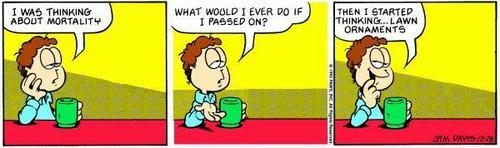
Arbuckle= Social Angst/ Depression/Loneliness Commentary


Something I discovered a few months ago that I've been meaning to share is this brilliant blog that takes Garfield out of the Garfield comics. Here's what the site says about itself:
Garfield Minus Garfield is a site dedicated to removing Garfield from the Garfield comic strips in order to reveal the existential angst of a certain young Mr. Jon Arbuckle. It is a journey deep into the mind of an isolated young everyman as he fights a losing battle against loneliness and depression in a quiet American suburb.
Check it out!

August 7, 2008

August 6, 2008

A Protestant Saint?

Since leaving seminary and beginning my work as a pastoral resident I've been asking myself the question of how I'm going to engage theology while remaining faithful to the task at hand, my job. My fear is that I'll leave behind something I love (theology) in the midst of the craziness of life OR that trying to engage in a continual study of some kind will distract me from my work.

To experiment I thought I would study Bonhoeffer's works and thought. I figured of all the choices out there, Bonhoeffer would be a strong friend in my ministry setting. I'm not sure how this will work since I'm also coupling my mentoring to finish my M.Div. this fall to graduate in December with my residency. With mentoring I'll be reading 6 or so books this fall, which isn't alot except that I'm also trying to figure out work.

I've already read a few books on or by Bonhoeffer: The Cost of Discipleship, Life Together, & Psalms by Bonhoeffer and The Bonhoeffer Phenomenon by Stephen R. Haynes. Inspired by a few friends who have recently read or are reading Bonhoeffer I'l be picking up Ethics, Sanctorum Communio, Letters and Papers from Prison, Bethge's timeless biography and I'm currently reading Christ the Center. I'll probably return to The Cost of Discipleship a few times, since I haven't read it since college.

There are many reasons why to choose Bonhoeffer, but his context and death in a Nazi concentration camp, his life, and his Christocentric theology that pushes for church reform are just a few.

Picking up where we (I) left off...

Well, the time has come to finally blow the dust off my keyboard and get back to blogging. Okay, maybe the dust hasn't collected on my laptop, but it was nice taking a break from blogging especially because since coming back from India this summer has been a bit crazy. I realized that I picked up some readers during my India trip, but probably lost them all so to my two faithful readers I'm back!

I'm not sure where to take this blog now that I'm entering a new season in life. I'll probably be posting more on my failure and the messiness of life transition for a while, until I can - if I can- get a hold on things post-seminary. For sure I'll be posting thoughts on what I'm reading, giving some reviews, and talking through my context here at FBC Austin as the Pastoral Resident.

It's good to find some routine again, especially since I feel like I'm coming out of reverse culture shock. I'm finding being an American Christian, or better Christ follower, an interesting enterprise again. Hopefully I'll be able to post up a few things on what I'm reading, watching, and what has been going since I got back.

June 24, 2008

Out of the Blur...

Sorry I haven't posted in so long. We didn't have any good internet spots for the last week in India, plus I flew into Texas and went straight to youth camp. From camp I had a weekend, and this week we're doing VBS. So with no internet at the apartment I haven't had the time or care to post. There is so much I missed the last week in India so here's a brief and short recap. To conclude the class I have to write a reflection paper, so hopefully in the weeks to come I'll get some thoughts on India and my experience posted.

Notables:
  • I mentioned this last post but we met a Hindu Christ follower (HCF). I'll post more on this phenomena later, but it's an extremely intriguing movement of Hindu's remaining with Hinduism but turning to Jesus as their guru, leader, lord, then God.
  • Meeting the HCF was a rare and great experience. The HCF is probably one of the important voices in theology today in that he is a contextualized and living Indian bowl, doing theology in the South...the future (as in tomorrow) home of Christianity. The tone and theology of this Indian Christianity was beautiful and did not reflect Christendom, but the Kingdom of God.
  • The following night in Varanasi we witnessed a Puja or Pooja to the Ganges river. Every night in Varanasi hundreds, if not thousands, of men, women, and children gather to offer up worship to the god or river. The city at any given moment has 1 million pilgrims in it either to puja to the river or to die at the river.
  • Having these two very contrasting pictures of worship and God/god has been very good, challenging, and provoked many good conversations.
  • We shopped some in Varanasi and in one of the back alleys some random Indian guy tried to sell me India's finest marijuana.
  • We took another 12 hour train ride from Varanasi to Agra, the home of the Taj Mahal.
  • The hotel, Taj View Hotel was beautiful. The city was okay, but a tourist trap...way to expensive.
  • We went to the Taj Mahal...yes, I've seen one of the 7 wonders of the world. The Taj is an amazing and beautiful structure.
  • One of the most amazing parts of this trip was spending a month with 12 friends and Truett companions. One night in Agra we had a pizza party and spent that night encouraging and showing love to one another. The air was full of grace and love, full of cherished memories and truly meaningful words. I grew to love all 12 of my friends and miss them.
  • From Agra we rode a bus for about 8 hours to Delhi. Delhi is the capital and most Western city of India. This may have been one of my favorite cities, because we were able to meet and spent some good time with some missionaries in the city who are working with the Hindu Christ follower movement. Also, they cooked us Mexican food, mango salsa, and cake.
  • At the missionaries home, other students who are spending their entire summer in India and we held out own contextual Satsong and Puja to Jesus. It consisted of India songs, learning the story in Luke about Jesus crossing over to Legion in the land of the Gerasene, questions, rehashing the story ourselves as a group, praying, praying, and praying more, and the Lord's supper done with coconut. It was a good experience, because in Minneapolis we began with a satsong and I felt it was more of a spectator event for myself, but in Delhi I was able to worship.
  • We flew out of Delhi and since then everything has been a blur. The flight from Delhi to Hong was 6 hours I think, then a lay over for 4 hours, then we flew to San Fran in 12 hours and missed our connecting flight so I flew to lil' John Wayne Airport in Orange County, CA then I flew into DFW. I landed about midnight and was so excited to see my wife.
  • CHARLOTTE! She was at the airport waiting, it was a glorious reunion.
  • The next day I went to camp, which was great. I enjoy the youth at FBC Austin, they are fantastic. This week we are doing VBS. I really I'm not clear about my job still, but orientation through camp and VBS don't quite show normal, daily routine.
  • I'm excited to be home. I missed Char so much and have enjoyed getting to tell her about the trip. I miss India, especially my friends. The trip was excellent and more then worth it.
  • Thanks to everyone that supported me, no matter how much or manner.

June 11, 2008

Day 26- Varanasi

After riding the train for about 11 hours from Calcutta, we arrived yesterday in the oldest and holiest city in India, Varanasi, home of the Ganges river. The frustrating thing has been that it is very difficult to appreciate the culture, rituals, or religion because it often seems that we are walking dollar marks. It's hard not to want to withdraw and get jaded, but at the same time this is just one of the ways these people who are poor make money. The questions about taking up my own cross and allowing myself to get cheated and what does it mean to love these people who are so different continue to sound in my ear.
Notables:
  • Slept well on the train.
  • Varanasi, probably because of the river, has a repugnant and strong smell. Plus the city all around has a different feel, animals fill the streets, especially cows.
  • We were able to view part of a funeral ceremony yesterday. Traditionally, Hindu's want to be burned and spread or floated along the river.
  • Last night we met a Hindu Christ follower. We talked with him for about 5 hours. I feel like we've been waiting to meet him since Minneapolis. We had really good conversation and many questions were answered.
  • It's strange knowing that I only have 6 or 7 days left until I'm home. I missing Charlotte more, so pray that I'll be able to be here and remain engaged. Also, please pray for camp stuff. Youth leave this Sunday for camp and I fly in on Wednesday and will probably go to camp either that night or Thursday.

June 9, 2008

Day 23- Calcutta & Mother's House

It's been a while so I'm not sure what all to include. My health has returned, which I'm really grateful for because it was getting really hard to not focus on myself and my own suffering to see all the suffering around me. This last part of the trip for myself seems to have taken a turn from a more tourist type feel to being here to act, love, and be transformed.

Highlights:
  • Saturday we saw Indiana Jones in an Indian theater...not that good of a movie.
  • Sunday we attended Mass at the Mother's Home, Mother Teresa's home. I had the honor of reading scripture in the service. Looking out into a crowd of sisters while reading Hos. 6:3-6 was very humbling.
  • Then we attended a Baptist church founded in 1811, it was very different then the Mass. The most suprising thing was the larger number of young people at the Baptist church.
  • On Monday and Tuesday one part of our group worked at an orphanage, while the other part that I was a part of worked at the House of the Dying. There is so much to be said about this place. I really liked getting to meet volunteers from around the world. Also, there is so much to be said about creating an environment of dignity. The Hous of the Dying is a place of life. Furthermore, after meeting a few men in the house that spoke English, I was reminded how nothing is promised in life.
  • Later today we leave Calcutta on train. Hopefully it will only take the projected 11 hours, not the 25 hours that it took someone else we spoke to.
  • General health for the group is well, except for w few. Continue to pray for us, that we'd seek to learn how to be open and what it means to follow Christ more deeply.

June 2, 2008

Day 17- Cochin, Cherai Beach Resort

This morning we are about to leave to Jaipur, but the last few days have been about slowing down and learning about ancient Hinduism while sleeping in some pretty plush places. This, our second resort, is located right off the Arabian Sea. We went body surfing a few days ago in it.
We've visited alot of historically important places in Cochin and Mamallapuram. In the latter we saw five different ancient Hindu temples. In Cochin we visited the oldest church built by the Portuguese in 1503 in India.
Although it has been nice to slow down and learn about Hinduism, I think the entire group is ready to move on. The next two weeks are going to be much more hands on, engaging, and about meeting Indias. This also means that the next two weeks are going to get much harder.
I'm not sure where we are staying, so I don't know when I'll get to post again.
Notables:
  • I'm struggling with identifying myself as an outsider in relationship to the "other," that being the Hindu, Muslim, Idian etc.
  • The resorts have been nice, which is good because several of us got sick. Pray for health because it's going to be much harder to be sick in some of th eplaces we're going to.
  • I've learned enough about Hinduism and Indian culture that I'm really confused.
  • Sometimes ministry is about taking a stab and working from there.
  • The novelty of India has worn off, thus culture shock is settling in. I'm much more calloused toward the shopkeepers, vendors, and beggars then I was before.
  • Last night we had a variety show. The guys sang a song and the girls had a melody of songs. All of them were rewritten to include funny and memorable experiences from the trip thus far. I'm really enjoyng my traveling friends.

May 30, 2008

Day 13- Mamallapuram, Ideal Beach Resort

Sometimes it could to break in a hard trip, thus we have officially landed in the nicest place I've ever stayed, besides the cruiseship for my honeymoon. This place is amazing, located off the Bengali Bay in the India Ocean.

We arrived yesterday and are leaving tomorrow morning for Cochin. Most of today we spent touring ancient Hindu statues and monuments. I would love to share more, but the internet here is extremely slow so I need to go...to the beach!

May 27, 2008

Day 11- Hyderabad

Today ends our journey here on our first leg in India. We mostly took the time to tour the city and spend some time shopping. We were able to see the man made lake that separates the twin cities and then go into the heart of the Muslim part of the city. We visited a Mosque that experienced a terrorist bomb last summer. They were gracious enough to allow the men in our team into the Mosque, it was really good and I was able to pray for peace in that place. Next to the Mosque was Charminar, an old, old structure. You should google it. The last site we saw was the 7 tombs, that were very large and amazing structures outside the city. Apparently I'm popular among the youth guys of Hyderabad, several groups came up to me and wanted to take pictures. It was fun.

The best part of today was meeting a Muslim Christ follower who is working for among the Muslim middle class for house church planting. Please pray for Shake.

Tomorrow we fly out to Chennai, then the next day we get on a train to Cochin. I'm really excited to Cochin, the seat of a successful socialist/communist state in India. Also, this is the purported place of Thomist Christianity in India. India Christianity has the possibility of being as old as the Apostle Thomas, yes doubting Thomas from the Bible.

Continue to pray for Jeff's foot, it is rather swollen.

May 26, 2008

Day 10- Hyderabad


Today we volunteered and served at a local HIV/AIDS clinic. There is so much that I could talk about, so I'll limit it to a few things. First, this is my first encounter and interaction with HIV, and I was able to pray for and be prayed for by Opang, an HIV+ counselor at the clinic. Having a face and story to put with something that is so demonized in our culture sometimes really is breaking. I really appreciated his story.
Also, I met a volunteer, Daniel who got my email. We discussed postmodernism and Christianity, it was really neat. Finally, the most humbling experience is to see these people's faith. Many of the Indians that we've had conversations with or who are ministering to India absolutely love Jesus and rely desperately on their faith. I'm so humbled to pray for and be around these Christians, it has challenged my faith.
Oh, one last note, theology is messy when it hits the ground. I think one of the biggest ways of bridging the gap between high theology and praxis is giving ourselves permission to fail. We need to give our space to experiment and to simply do something, to love people and trust in God to be faithful.

May 25, 2008

Day 9: Hyderabad, India

Yesterday we arrived in India after a long flight. We all lost sleep since our flight departed Hong Kong and we arrived in Delhi at 230am, then from Delhi to Hyderabad at 630am, I think. This place is signifigantly different then Hong Kong, much more foreign and poor. I think there have been two key adjectives in describing India thus far: the land of contradictions and struggling. Although India is growing economically, the cities are still smattered with broken buildings, atructures, and people. Two former missionaries to India have really helped guide us here in Hyderabad, Robbie and James (Pancho), who I found out go to the same church that I just got a job at.

Notables in Hyderabad:
  1. Mango Season! Fresh mangos as well as bananas have been really, really good.
  2. Beggars- I'm still not sure what I have to offer or what the proper response should be, the situation is complex
  3. Theology is messy on the ground. With a growing middle class in Hyderabad because of the developing IT market, the church we attended this morning was very, very Western. It was like they were taking Bill Hybels and directly applying that methodology here.
  4. Please pray for me, I got a sinus headache today which almost put me out of commission. I hope that doesn't occur very often.
  5. We met and had lunch and tea with a wonderful Indian Christian family that ministers to a certain people group. It was great to spend time with them and see how this culture talks about Jesus and what God does in their lives. Pray for Lazarus (Sing Saey) and his wife and family.
  6. Traffic here is unbelievable and crazy. Where there is a void, a car, person, taxi, motorcycle or goat fills the gap. Plus, we've had some crazy drivers.
  7. Tomorrow we are going to work at an AIDS clinic all day.
  8. We've eaten India food as well as pastries from a bakery, KFC, Pizza Hut, and lots of water. So far no one has gotten sick, except for my headache. The India food is good, I like the different dishes and spices. Yogurt is my best friend, because you mixed it in with the spicy food and it helps control the temp in your mouth as well as your stomach.

May 23, 2008

Day 7- Hong Kong to India


Today, we've spent the majority of the morning and afternoon in HK with a businessman who is developing a coffee company in SE Asia. I really respect and enjoy the man. Overall, the morning was good and lunch was very tasty. We ate authentic Hong Kong (Chinese in essence) food called Dim Sum(n?). They bring out the portions as they are made, so I ended up eating way to much. I do really enjoy this culture, food, and city. Hong Kong is one of my favorite cities now for sure.


After a short rest here at the palce we're staying, Tao Fong Shun retreat center, we'll head to the airport and fly out to Delhi at 10pm. In Delhi, we'll stay for several hours, go to the domestic terminal then travel to Hyderabad. Sometime in there I present on Hyderabad, which I should be an expert on by now since I met a man from there on my 14 hour flight to China and he told me all things good about the city.


So far the trip has not been overly difficult or challenging, but that will all change once we hit the ground in India. It seems so strang that we've been gone for near a week, but we still are not in India. Yet, I find myself less and less ready, because the difference, culture, and people will be extremely different.
I'm not sure when I'll be able, if at all to post pic's.
Pray for our group. Jeff scraped his knee yesterday, so we don't want that to get infected. Groups dynamics are playing out and people are growing together. There has been no conflicts, but it is only inevitable. Continue to pray fo rour safety and groups relations, communications, openness, and honesty.

May 22, 2008

Hong Kong 6


Yesterday after our 14 hour flight we landed in Hng Kong at 630 am, and spend literally the entire day marching throughout the city. My first impressions of Hong Kong was that it was beautiful, green, and very Western. The islands is tropical with low mountains, thus making for beautiful backdrops to the seemingly endless skyscrapers. Our second day in Hong Kong, we again marched throughout the city on the infamous Dr. Stroope March. Even though I'm still jet lagged, I'm feeling really good. THe trip has been and is getting better the more I'm getting to know my team mates and get back to normal.

Notables:

  • The Hong Kong subway is very efficient, very.
  • I could like in this city.
  • The city has lots of color and is tropical.
  • We visited a Buddhist garden and Temple where we saw people practice Taoist rituals.
  • I'm asking questions about myself personally, what I believe and what are my passions.
  • It is interesting to take the many conversations and ideals that have evolved in seminary and see how the reality of life and the world makes distinctions, classifications, and high ideals so messy.
  • I like my team...so far!

Future:

Tomorrow we will be in the city until 10 pm then we fly out to India. We fly into Delhi then go straight for Hyderabad. I present on Hyderabad tomorrow. Dr. Stroope said that things change after about two weeks into the trip. I'm both looking forward but anxious about this time. I wonder what it will look like when all of our personalities are more open and are being made vulnerable.

May 18, 2008

Day 2- ReThinking Forum


A few notables from today's (our last day) from the forum:
  1. We were lead in "contextual" Indian style worship by Arandha, an incredibly talented group, Berkley trained, and yes the lead man plays the guitar. 
  2. Dr. Stroope gave a paper today on the identity of the outsider.  It was really good.  The insider (the local, indigenous people) need to be local, and outsider's must recognize that they can never be an insider because of enculturation.  Thus, instead of vocation we must focus on formation.  Not what do I do, but who am I becoming.
  3. EGG story!  Today for breakfast I went downstairs for the continental breakfast at the Inn.  In the fridge there were hard boiled eggs, which sounded good.  So I pulled one out and thought there is no way I'm eating a cold, hard boiled egg.  Along with my pancake, sausage dog I placed the egg in the microwave.  After about 30 seconds, I pulled out the egg and pancake dog and took about 4 steps toward my table, then BOOM!  Apparently hard boiled eggs, and there was no shell mind you, do not go into the microwave.  The thing exploded everything:  the wall, the window, curtains, floor, the side of Jeff's face, Sarah and Mary Beth's hair, and ALL over me.  My face, beard, shirt were covered in egg and everyone was looking at me.  What do you do when a room full of strangers are staring at you.  All I could get was, "I'm okay!" while covered in eggs.  It was great!
  4. Tomorrow, we fly out and it'll take a while to get where we're going.  So along the way, there will be plenty of time for conversation and being together in a group.

May 17, 2008

Love of my life!


Today begins one of the longest periods my wife Charlotte and I have ever spent apart.  A few weeks ago we moved into our new apartment into a new city.  The last two weeks have been rather crazy, getting reading to go, packing, finishing the semester, etc.  

Fortunately, in the midst of it all we were able to spend some good, quality time together.  This morning our goodbye was somewhat hurried I felt like, but the last few days was excellent.

I'm not sure how to say goodbye to the person I love the most and wish more then anything she could be here.

In some sense I need to lean in and make sure I engage in this trip with this group of people, while never letting go of Charlotte.

So, I love you babe and miss you much already.  You are strong and I really love spending my life with you.  

Day 1- Rethinking Forum

Well, it's nice to finally be on the trip.  We've been building up for months, preparing, reading, packing, and meeting and finally we are on our way.

Today began our first day.  This first leg began with  two hour flight from DFW to Minneapolis for a two day hiatus, also known as the Rethinking Forum.  Basically practitioners, scholars, and people interested in the conversation about mission to Hindu's have gathered for a few days to talk about contextualization.  

My first impression has been very different from most conferences I have attended.  This forum is very intimate.  I feel like this is a conversation among peers, partners, and friends.  This is a very important conversation, but like most conversations that push beyond the veneer and surface level of what we often call "conversation" the discussion can become frustrating and difficult to maintain.  So like this conference, this is trip is about a difficult and sometimes frustrating conversation.

Not that I think this trip will be bad or even overly hard, but to fully engage and get everything out of this conversation it will take effort and be hard at times.  

Tomorrow we go back to the conference and Dr. Stroope will be presenting a paper.  Monday, we take the morning to rest, fly to DFW with a layover, then to San Francisco with a layover, then we fly out to Hong Kong for the long 13 hour...23 hours with time changes ;) 


May 16, 2008

Journey Begins Tomorrow...

Today I'm putting the final touches on packing, chapstick, toilet paper (for roadside toilets in India), jacket, malaria meds bought in Mexico. Everything fits quite snug inside my pack, which I'm hoping to take as my carry-on.

Tomorrow we fly out at 8:00am to Minneapolis for a Rethinking Forum on Mission to Hindu's until Sunday. Then we fly to Hong Kong for a few days to get out feet underneath us. When we're used to the time change, we'll fly to Delhi and start our time in India where we'll be for the majority of our time.

I plan on updating on this blog to let all my faithful readers, all two of you, to know where I'm at, what, we're doing, and all that good stuff. So, check back every once in a while. I'm not sure how often I'll update, but hopefully more often then not.

May 14, 2008

Packing for 37 days


Total of 37 days, mostly in India:
  • 1 Gregory Palisade 80 Backpack
  • 3 T-Shirts- 1 Exofficio & 2 cotton/poly blends
  • 3 Pants- 1 Convertibles, 1 Cargo, 1 Linen & Cotton blend
  • 4 underwear- 2 exofficio, 2 cotton
  • 3 pair socks- ankle hiking
  • 1 pair Chaco's
  • 1 Pair of running shoes
  • 1 Marmot Light Jackot
  • 2 Shorts- 1 swimming, 1 athletic, 1 pair normal shorts (possibly)
  • 1 Polo
  • 1 hat
  • 1 MSR Towel
  • 3 Books, 2 Journals- Bible, Kierkegarrd's Fear & Trembling (to read & give away), Peterson's Christ Plays in 10,000 Places, 1 Travel Journal, 1 non-ruled journal
  • 1 Under clothes passport & money holder
  • 1 pair of Pepper's sunglasses
  • 1 Watch
  • 1 Dry Sack- for dirty clothes, 1 compression sack
  • 1 Nokia NV10 Camera, 3 batteries, 2 1 gig cars, charger, adapter & case
  • Lots of pills, med's, toiletries, baby wipes, TP, glasses & contacts, bug spray, ear plugs
  • Misc papers for insurance, check card, flight receipts, etc
  • Most importantly- MYSELF, packed & ready to go!

May 1, 2008

Sad Day...


I'm sitting here in my last class ever in seminary. Although I don't graduate until December and still have mentoring for the Fall, this will be my last semester of class. Yes, I'm really excited about continuing on this journey and of course I'm excited that I have a job and a place to live. I have to admit though, that I will miss this place a lot, as well as the academic setting.

This time in seminary has been really good, but also really hard. I 've experienced everyday the deconstruction process, while being pushed toward healthy reconstruction. I had someone ask me today would I do seminary again and I said, "Yes, absolutely!" I'm not certain I'm in the place I wanted to be in leaving school, but maybe that's best. I don't have answers, but lots of questions and I'm okay with that. I'm just not sure how that will pan out in a concrete, church setting where everyone is looking for answers.

In my last class today, we read a story that almost providentially tells my story: the
Blind Men and the Elephant. I thought this story was the perfect way to end my seminary experience and begin the next chapter in life. As I'm preparing to leave and enter the "real" world, I'm still struggling how to structure and talk about what I believe and have experienced. How do I talk about being a Christian in Austin?