November 6, 2009

I should like to make a remark to him...

Soren Kierkegaard

One sticks one's finger into the soil to tell by the smell in what land one is: I stick my finger in existence---it smells of nothing.

Where am I?
Who am I?
How came I here?
What is this thing called the world?
What does this world mean?
Who is it that has lured me into the world?
Why was I not consulted, why not made acquainted with its manners and customs instead of throwing me into the ranks, as if I had been bought by a kidnapper, a dealer in souls?
How did I obtain an interest in this big enterprise they call reality?
Why should I have an interest in it?
Is it not a voluntary concern?
And if I am to be compelled to take part in it, where is the director?
I should like to make a remark to him.

via.

October 27, 2009

The Long Silence

It's been mighty silent over here, I know. I have some many thoughts rolling around in my head I'd love to write about and talk about even more. But, as some of you know, I preparing to transition into a new phase of life. My residency at First Baptist Austin ends this May and so deadlines are rearing their ugly heads. Immediate goals are two fold and coalesce into what I'd love to do next. The most time consuming suck on my life right as of the last month and will continue until Nov. 23rd at 8am is preparation for the GRE. The reason...well, to apply to doctoral programs at various schools focusing mostly on political theology, ethics, missional theology, ecclesiology, economics, and the like. PhD app's to the schools I'm looking at are Dec. 15 and Jan. 15. Thus, trying to prepare for the GRE as well as research the schools and applications, has taken most of my blogging time.

Also, some exciting opportunities are happening around my residency come November. Besides the loathed aforementioned test, I am sharing my formation story with my church community Nov. 8th Agape meal, where we gather to eat together and worship Christ in our presence. Also, on the first Sunday of Advent, Nov. 29 I am preaching. The lectionary Gospel text is apocalyptic, and since I like a good challenge, I think I'm sticking with it, Luke 21:25-36. If I can manage to make the sermon accessible, I'll title it, "Living Violently in a Peaceful World," but we'll see.

So, I promise I'll return to this place for some rejoinder on the relationship to faith and science, on epistemological humility, Zizek, Bonhoeffer, politics, and maybe even why I'd title a sermon, "Living Violently in a Peaceful World."

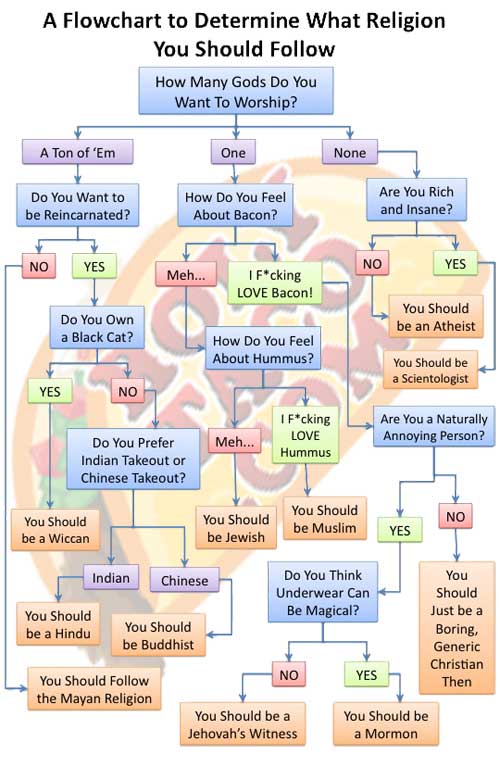
Religious Flowchart


I thought this was too good not to share. Enjoy:

via.

October 21, 2009

The World Exhausts its Rage

This love of God for the world does not withdraw from reality into noble souls detached from the world, but experiences and suffers the reality of the world at its worst. The world exhausts its rage on the body of Jesus Christ.

-Dietrich Bonhoeffer, Ethics.

October 18, 2009

Evangelical & Mainline Culture Shock

Here's a funny look at the culture shock, from both sides in ways that's a little snarky but light hearted, on the divide between evangelicals and mainlines. What would you add? via Tribal Church.

•Even though they love the environmental aspects of the screen, they might break out into a bit of a cold sweat when they see it in the sanctuary.

•They might bring their Bibles to church. Do not be alarmed when you see the book. Try not to stare. And don’t worry. They will figure out quickly that they’re not supposed to bring it.

•Their personal Bible in their pew does give them a little comfort because they can’t immediately tell the difference between hymnal, prayer book, and Bible in the pew. They will pick up the wrong one. At least until they figure out that no one else really follows along with the readings, because they are the only ones who know how to look them up.

•If they’re particularly moved by a solo, they will clap following it. Once. Until they figure out that it’s not okay. Then they will die a little bit inside.

•They never missed a Sunday at church growing up, but they don’t know the Apostle’s Creed. They are the ones mumbling “watermelon” when the rest of the congregation is proudly articulating every word.

•They might say “Amen” after the pastor says it. It’s just a reflex. And don’t laugh at them if they use “just” in their prayers. At least they know how to pray in public.

•They are the people who would rather leave their right arm than leave their email address.

•They may not have been going to church for the last ten years, because they were afraid that they couldn’t afford it.

•If they happen into a denominational church during Stewardship Sunday, they may never come back. Only because, in their mind, asking for money is what church is about every Sunday.

•If they hear how much your church is involved with helping the homeless and poor, then they will start to breathe. And they might be able to leave something in the offering.

•If you mention that your church supports LGBTs, then the muscles in their neck will loosen. They will be utterly confused, but very relieved.

•They are confused by communion. They might not have even ever participated in communion before.

•If someone tries to hug during the passing of the peace, they will have finely-developed defense mechanisms in order to shield themselves from the Holy Spirit chest crunch.

•If the pastor learns their name after a couple of weeks, they just might faint dead away.

•If the church has a discussion about having a “contemporary” worship service in order to reach out to more people, they will assume that you’re trying to get their parents to come to your church.

October 12, 2009

Columbus Day, a Hard Pill to Swallow

From the journal of Christopher Columbus:

In all the world, there is no better people nor better country. They love their neighbors as themselves, and they have the sweetest talk in the world, and are gentle and are always laughing.

They… brought us parrots and balls of cotton and spears and many other things, which they exchanged for the glass beads and hawks’ bells. They willingly traded everything they owned … They do not bear arms, and do not know them, for I showed them a sword, they took it by the edge and cut themselves out of ignorance … They would make fine servants … With fifty men we could subjugate them all and make them do whatever we want.

As an explorer, Columbus was not the first to reach the Western Hemisphere. Native Americans had been here for 10,000-20,000 years, and Vikings and Chinese are among those others who hold prior claims. Even after four attempts, Columbus never realized his goal of finding a western ocean route to Asia. As a “founding father type figure” he never set foot in what is now considered America but landed in the present day Bahamas, Cuba, and Haiti. As a Christian example he enacted terrible cruelties to friendly natives: assuming unlawful rights of authority; robbing and subjugating whole nations of their freedom and entire capital; allowing his men to rape, murder and pillage at will; and deliberately leading the way for the genocide of millions, considered by many to be the worst demographic catastrophe in recorded history.

So why do Americans celebrate Columbus Day?

Read the rest.

For a fuller history lesson on Columbus and the atrocities committed by him and his voyagers, see Eliacin's blog for a longer passage from a A People' History of The United States.

October 6, 2009

Everything is OK


Interesting indirect communication, I liked it.

October 1, 2009

Some Banksy Animations

Pete Rollins posted these over at this blog, and I found his reflection true. The true power and beauty of Banksy, a Christian anarchist, is his anti-celebrity, his anonymity, and his powerful artwork...which is more powerful because of the first two things. To quote Rollins:
In a world where, to quote Kierkegaard, leadership so often reflects the tyrant (the one who leads from their ego) it is rare to find leaders who are martyrs (who have laid down their ego and are driven by something greater).


Pass this on!

September 28, 2009

Torturing Reality


Since switching over to Netflix from Blockbuster I've only received one movie through the mail, a movie every American should watch: Taxi to the Dark Side. My first reactions were the feeling of being crushed, angered, and a desire to change change the status quo for politics. Often I get so frustrated with my fellow compatriots and myself for our short memory. With a new president to distract us, all the talk about torture and these secret war prisons have in the least subsided to a whisper.

Torture is disgusting in every form and should be regarded as an enemy of humanity, an unnecessary evil. It transforms our imaginations as US citizens (35% of the population sanctioned torture AFTER seeing pic's from Gitmo).

Politics has become a matter of using and manipulating language to create a reality so that people remain ignorant about reality. As I've mentioned before, I believe the most patriotic act a person can do in this climate of phobia and manipulated reality is to call awareness and repentance to our country's ills and brokenness. Torture is a crime against all of humanity, even the perpetrators.

Something I've been wrestling with since I've began to understand Political theology and Slavoj Zizek is the pressing question, how do you bring about a new political order within the old politic? As the documentary I just watched points to, the Cheney/Bush administration seems to have done this in eight years to an extent. Under this administration the US defied the Geneva Convention and the USA Constitution by (re)defining the terms and at other times propping security and safety over against "the self-evident truth that all men are created equal."

So is this the best way to bring in a new political order? Having a powerful administration that manipulates the people through false records and ambiguous language?

I would hope that this isn't the only answer. It could be the real solution is found in the cross, in the broken body of Christ that recreates humans in the image of a given and estranged God, uniting the isolated and creating a body given to all. The church is a political body by its very existence, thus it must be first faithful to its calling to serve and suffer, while bending reality toward God's love and justice.

Pirates, Orthodox Heretics, & the Betrayal of Betrayal

Probably the most interesting conversation on the emerging church/theology blogosphere right now: Pirates, Orthodox Heretics, and the Betrayal of Betrayal (thanks Kester for rounding up all the links).

September 24, 2009

Moltmann & Homosexuality: A Bit Disappointing & Not in that Way

From everything I've read, I don't think Moltmann explicitly addresses homoseuality. I've had lots of theoretical conversations and hypothesis on what he "might" say about it, even at the Emergent Conversation over lunch. Over at the Moltmann Yahoo group, there was a discussion on what Moltmann would say about it, but since it was merely speculative it shows that he doesn't talk about it in his works clearly or directly.

So when at the Emergent Moltmann Conversation when Tony Jones put the questin to him, I was excited. Yet, I found his answer rather disappointing. Moltmann answered, "The church in Germany doesn't struggle with the problem (referring to the schismatic nature of ordaining homosexuals or blessing partnerships in the USA), because we are about the Gospel and not about sex. We believe in justification by God's work, not human work."

Some other things he said that I thought were provoking were that gay or straight can be ordained to ministry. Also, he wouldn't say (and this is what I thought most interesting) that a gay partnership is equal to marriage between a man and woman, since "marriage is to further children." Yet he would have no problems blessing such a partnership, "why not bless a partnership? Homosexuality is neither a sin or a crime, like near-sightedness is neither a sin or crime. I don't understand the schism or heat of the debate."

For such a deeper thinker, I was somewhat surprised how surface level and simplistic his answer was even though it was simply a conversational format. Yet, to say that Germany is worried about the Gospel and the church in the USA is not is overly simplistic and not a valid depiction of cultural realities. Germany carried(ies) a national guilt so intense that Moltmann himself says many of his comrades in POW camps didn't survive the shame. It makes sense that Since WWII, Germany would be intentional, even overly intentional to be very inclusive and not prejudice. America doesn't have this cultural history, but a very different story. So, I felt like this statement was simply unfair and unrealistic.

Also, he's okay with ordaining gay ministers and blessing partnerships, but he never called the partnerships marriages and actually compared homosexuality to a physical defect. Obviously he sees homosexuality as being less than a healthy (read: normal) human. Will the resurrection, the New Creation where all physical defects will be healed have homosexuals? Why not if this is truly who they are? Is homosexuality simply a distortion of the created order? Is homosexuality an illness, sickness, or defect that should be "fixed" by genetics manipulation if possible? This is where I find his words to lead.

Furthermore, since marriage is intended to further children and for that reason homosexual partnership is less valuable or "not equal," does that make a marriage between a man and woman with no children less than equal to a marriage with children?

Is marriage simply about furthering children, or is this a proof text from Israel's creation story that is irresponsible in a world of almost 7 billion people?

Overall, I was excited to hear Moltmann's thoughts about this issue that has become so divisive in the USA and across the world in many denominations, but I left disappointed and unchallenged. What do you think about Moltmann's assessment and thoughts?

September 19, 2009

How about something funny

80's video dating montage...or "yay for self (lack of) awareness"

September 18, 2009

I'm Twittering, or Tweeting, or whatever's hip

So I haven't necessarily "given" in to twitter as if I was actively trying to stay away from it, but it has been on my mind for some time now. Of course Lucas introduced me to it and has had an account for some time, so I didn't want to follow suit too soon. But at the Emerging/Moltmann Conference twitter was really integrated into the conversation, so I decided to create an account.

So follow me, if you dare... @joebumbulis

Constantine's Christianity & POW's

For my second reflection I want to mix two things Moltmann said. One of them is his beautiful story as a POW as a youth, overwhelmed with grief and shame, and the grace he received at the hands the British.

The second is a quote in reference to the cross, where Moltmann said that there are two crosses in Christianity, the cross of Golgotha and the cross of Constantine's dream. One is about resisting the polity of society for the horizon of hope. The other is based upon a sword, power, and is what we call Christendom.

While I agree that the usurpation of the cross and Christianity by the Romans was a tragedy and since then we have had a very imperial form of Christianity in the West, I think Moltmann's story itself reveals the tragedy and irony between these two crosses. First, we must approach Moltmann's story.

Understanding Moltmann really helps to understand his theology, because instead of a system he is creating reflections and contributions based on his life journey and conversation with those he encounters along the way. Moltmann's theology didn't in his home where he was born into a secularist family reading Goethe and Nietzsche. At 16, Moltmann unwittingly joined the Hitler Youth Movement and went to war, the front lines I believe at age 17.

Moltmann never once fired a shot, but when the opportunity came he surrendered himself to the Ally forces. His life in Germany was surrounded by firestorms, bombings, and death. The question for him became not so much "Where is God," but "Why am I still alive and not dead like the others." Or, "is there any meaning to life?"

As a prisoner in war camps in the UK, Moltmann found that no only was his body, but his very soul was imprisoned. Like I said before, Moltmann had no idea what was happening pertaining to the concentration camps. In prison, pictures were posted in their stalls so as to realize what was happening in Germany under Hitler. Moltmann says his life was almost suffocated with the guilt of his people and nation. Many Germans in POW camps didn't recover hope or the will to live after learning about such shameful acts under Nazi Germany.

There are a mixture of two events that recovered Moltmann's will to life. The first was a blooming cherry blossom tree where he was overwhelmed for the "blooming of life." This gave him some hope for new life. But in the camp, his old affection for Goethe and Schilling waned as he didn't find words for his experience. Rather, his captures treated him with grace. One day a young minister gave him a Bible where he began to read it and found the words for his experience in the Psalms of Lament (esp. Ps. 39) and the words of Christ in Mark, "My God, My God, why have you forsaken me?"

The crucified and forsaken Christ resonated with Moltmann. "Christ found me in the dark pit of my soul," forsaken behind the barbed wire of the camp. Moltmann was later given more grace upon grace by his captors, being transferred to a YMCA camp, trained in Greek and Hebrew while a prisoner, and read his first theological book: the Nature and Destiny of Man by Niebuhr.

So here's the amazing part of this entire story. 10 years after the war, Moltmann and some others returned to their place of imprisonment to the astonishment of the British. Who goes back to their place of imprisonment, especially during a time of war? For Moltmann and many others, they received so much grace at the hand of their captures, that grace was their salvation. They returned because of the amazing gift of grace they received while imprisoned.

Of course in reference to this gift of grace at the hands of the British soldiers..."the enemy, Moltmann quipped prompted by a question that he cannot understand the atrocities of the US prison camps like Abu Grahb, etc. "It's more convincing to love your enemy than to hate and kill your enemy. so what happened in the prisons in Iraq is outrageous and I cannot understand an administration that allows that to happen. To give grace is wiser policy than so called enemies."

Now, if you are still following me, here's the point I wanted to make: the irony of Christendom is that grace and God worked and work within it. It has become normative to run from, critique, and vehemently oppose anything attached to Christianity under Christendom. The "holy era" was the first 3 centuries of Christianity, the rest has some bright spots but for the most part is covered in blood and a church co-opted for imperialism.

In no way do I want to defend the Christendom church, but I do think it's important to embrace the ironies here. It was under Christendom Christianity that Nazi Germany and concentration camps happened, but it was also under this same Christianity that British soldiers treated their enemies with so much grace that is was salvation for them, so much so that one of the greatest theologians of our time was born out of their gift. There is no broad and simple divide between Christendom= bad; everything Christian= good. The two bleed into one another and it is not fair to only treat Christian history in light of the imperialism, sword, and death.

Moltmann was saved under the shadow of the cross of Constantine's dream, or was that simply the cross of Golgotha breaking through the dream? What do you think? Is it realistic to bifurcate the cross, imperial Christianity and suffering Christianity? Do they mix like water and oil, or more like milk and chocolate?

September 17, 2009

Closing the book on the Bush Legacy

"Thursday's annual Census Bureau report on income, poverty and access to health care-the Bureau's principal report card on the well-being of average Americans-closes the books on the economic record of George W. Bush.

It's not a record many Republicans are likely to point to with pride.

On every major measurement, the Census Bureau report shows that the country lost ground during Bush's two terms. While Bush was in office, the median household income declined, poverty increased, childhood poverty increased even more, and the number of Americans without health insurance spiked. By contrast, the country's condition improved on each of those measures during Bill Clinton's two terms, often substantially."

via.

September 16, 2009

Science...based on faith

Dan Brown, author of the Da Vince Code thinks so,

Are you religious?
I was raised Episcopalian, and I was very religious as a kid. Then, in eighth or ninth grade, I studied astronomy, cosmology, and the origins of the universe. I remember saying to a minister, "I don't get it. I read a book that said there was an explosion known as the Big Bang, but here it says God created heaven and Earth and the animals in seven days. Which is right?" Unfortunately, the response I got was, "Nice boys don't ask that question." A light went off, and I said, "The Bible doesn't make sense. Science makes much more sense to me." And I just gravitated away from religion.

Where are you now?
The irony is that I've really come full circle. The more science I studied, the more I saw that physics becomes metaphysics and numbers become imaginary numbers. The farther you go into science, the mushier the ground gets. You start to say, "Oh, there is an order and a spiritual aspect to science."
via the Parade interview.

I don't believe Science does what it presupposes it does. I believe as much as religion is a value system, science too is a value system and not merely as objective as it claims. Yet, I don't believe the world is 3000 or 4000 thousand years old, nor that it was created in 6 days. I'm neither against science (creationists) nor for science (Dawkins, Harris, etc). Science has a role, yet it is reductionistic and faults when it doesn't admit that it is by nature limiting and reductionistic.

Top 10 Reasons Men Shouldn't be Ordained

I love this.

10. A man’s place is in the army.

9. For men who have children, their duties might distract them from the responsibilities of being a parent.

8. Their physical build indicates that men are more suited to tasks such as chopping down trees and wrestling mountain lions. It would be “unnatural” for them to do other forms of work.

7. Man was created before woman. It is therefore obvious that man was a prototype. Thus, they represent an experiment, rather than the crowning achievement of creation.

6. Men are too emotional to be priests or pastors. This is easily demonstrated by their conduct at football games and watching basketball tournaments.

5. Some men are handsome; they will distract women worshipers.

4. To be ordained pastor is to nurture the congregation. But this is not a traditional male role. Rather, throughout history, women have been considered to be not only more skilled than men at nurturing, but also more frequently attracted to it. This makes them the obvious choice for ordination.

3. Men are overly prone to violence. No really manly man wants to settle disputes by any means other than by fighting about it. Thus, they would be poor role models, as well as being dangerously unstable in positions of leadership.

2. Men can still be involved in church activities, even without being ordained. They can sweep paths, repair the church roof, change the oil in the church vans, and maybe even lead the singing on Father’s Day. By confining themselves to such traditional male roles, they can still be vitally important in the life of the Church.

1. In the New Testament account, the person who betrayed Jesus was a man. Thus, his lack of faith and ensuing punishment stands as a symbol of the subordinated position that all men should take.

September 14, 2009

Whose Right(s)?

I'm offering some reflections on the Moltmann conversation an Emergent gathering held by JoPa. Moltmann in many ways has given me hope and grace for the journey, especially when I was in need of reconstructing my faith in seminary. I've several of his works and often return to his books for centering.

My first reflection comes from a mixture of statements from Moltmann:

In a "lightning round" Moltmann had to sum up a person in one sentence, ie "John Paul II"..."Good Pope."

In reference to Derrida, Moltmann only stopped after one paragraph saying, "Postmodernism is another form of modernity. Universal dangers exist toward humaity that we must meet united; so we cannot split up and everyone go in relative direction. whether we live in big or small narratives we all live under the threat of atomic bombs, ecolocial crisis; so extinciton of all is a possibility for all. So I don't see why we have to up universal questions or problems."

Also, in reference to the question of universal human rights, whether they exist or are unicorns; Moltmann answered in the affirmative. They are true, "this is good, for the growing world community based in human rights- or there will be no world community at all."

One of the things I truly appreciate about Moltmann's theology is that it is grounded in reality. His focus is less about the ontological reality of inalienable rights, but rather the need for justice and human dignity. Moltmann does not want people in any cirucmstance to suffer under the hands of dictators (his story is good cause...serving ignorantly under Hitler's Youth).

But, I am not sold on the modern idea of universal human rights, nor their ability to bring justice to peoples, nations, or even individuals. Instead of give my arguments, I thought I'd start with this issue because a good debate is already taking place online. Ben Myers argues against them here, Cynthia R. Nielsen responds, before Ben answers.

So, while I immensely respect Moltmann's theology and understanding of the world, it seems he is still conditioned to to embrace very modern ideals that simply don't exist and can't prove what they contend to prove: that apart from community humans have innate rights. I'm not sure I'm ready to locate universal realities outside of human reality, for then can be used as imperial weapons.


Some more blogs with reflections from the Moltmann Convo: TheSuburbanPastor and TwoEmptyHands. And Julie Clawson has her second reflection up.

Powerful, Pointed reflection on 9/11


As today, is September 11th, I thought I would engage in a bit of remembering — it is, after all, important to recall moments of our history, for this is the story in which we live.

On this day in 1973, Augusto Pinochet’s American-backed coup overthrew the democratically elected government of Salvador Allende. This resulted in seventeen years of torture, terror, and disappearances in Chile, and (according to people like Milton Friedman, who saw Chile as a textbook example of the type of world he wished to create) set a precedent for the way in which the United States acted in Latin America (particularly in the ’70s and ’80s… although they are at it again, as Obama’s government backed the Honduran coup which overthrew the democratically elected government of Manuel Zelaya in June of this year).

Sponsoring terror, imposing military rule, depriving local populations of their rights, their food, their land, their livelihood, their health, their children and their lives… this is the way that the US continues to engage with the world at large. It is enough to make some people want to fly planes into buildings. Which, not altogether surprisingly, is what happened on another September 11th.


from Dan at powerorprophet.

September 13, 2009

Listening to the Victims in a Recession's Racial Dvide

One of the greatest perversities growing out of our recent economic collapse and recession has been this ever growing sense of reverse racism. This idea that blacks voted Obama into office as some sort of savior, to rid the USA of white power and replace it with black power, and open the gates to illegal immigrants by providing them a free ride on the backs of white business and money. One naturally thinks of the republican congressman Joe Wilson's outburst last Thursday during Obama's health care reform speech when Obama stated that no illegal immigrants would be provided coverage under the bills in question.

Well, since this recession that inevitably happened under a black president, many Americans who have held power in this country ever since their distant family stripped (read: raped) the natives of it have felt threatened. What's at stake for white culture is the false dream and comfort of "life, liberty, and the pursuit of happiness" given to them (us) by powerful corporations with little to no disregard for human life. Wealth built off the backs of others, just like the olden days...but exported of course.

In a NYTimes op-ed piece writers Barbara Ehrenreich and Dedrick Muhammad named The Recession's Racial Divide, illuminate the reality behind the fear that the black community has won a "dictator and, in one image circulated among the anti-tax, anti-health reform “tea parties,” he is depicted as a befeathered African witch doctor with little tusks coming out of his nostrils. When you’re going down, as the white middle class has been doing for several years now, it’s all too easy to imagine that it’s because someone else is climbing up over your back."

At the Moltmann/Emergent conversation I just came back from one of the quotes that has stuck with me was something like, "those guilty of oppression, but want to enter into the truth of life must listen to their victims, because they can tell you who you truly are."

Never mind the fact the loan offices were encouraged by certain lending institutions to persuade black preachers to hold wealth seminars by providing a small donation to churches who did so, never mind that these same employees often referred to subprime loans as "ghetto loans" and minority customers as "mud people." We could talk about how it was the white culture that sold the black culture a false bill of goods, or that black unemployment is 8.2% higher than white unemployment.

Instead hear the words of the oppressed who have fallen on inexcusably hard time:

“There is no middle class anymore,” ... “just a top and a bottom.”

It’s not easy to get people to talk about their subprime experiences. There’s the humiliation of having been “played” by distant, mysterious forces. “I don’t feel very good about myself,” says the teacher in “American Casino.” “I kind of feel like a failure.”

The conclusion is poignant yet lacking:

So despite the right-wing perception of black power grabs, this recession is on track to leave blacks even more economically disadvantaged than they were. Does a black president who is inclined toward bipartisanship dare address this destruction of the black middle class? Probably not. But if Americans of all races don’t get some economic relief soon, the pain will only increase and with it, perversely, the unfounded sense of white racial grievance.
Is all this article is is a call for economic relief? While this is an important and worthwhile conversation what we need is call away from fear politics and a culture obsessed with power, driven by bigotry, and that has no place for real, constructive dialogue. What we need is to confront this unfounded sense of racial grievance and quit scapegoating Obama, the poor, and the "other."

What we very well need is a call to the cross, to suffer and give up our American dreams of power and wealth for American dreams of a society of care and responsibility for one another, a society of real democracy and pluralism, and society founded in the reality that "truth is found in unhindered dialogue (Moltmann)."